Showing posts with label Purim. Show all posts

Wednesday, March 20, 2019

Chag Sameach - Happy Purim 2019/5779

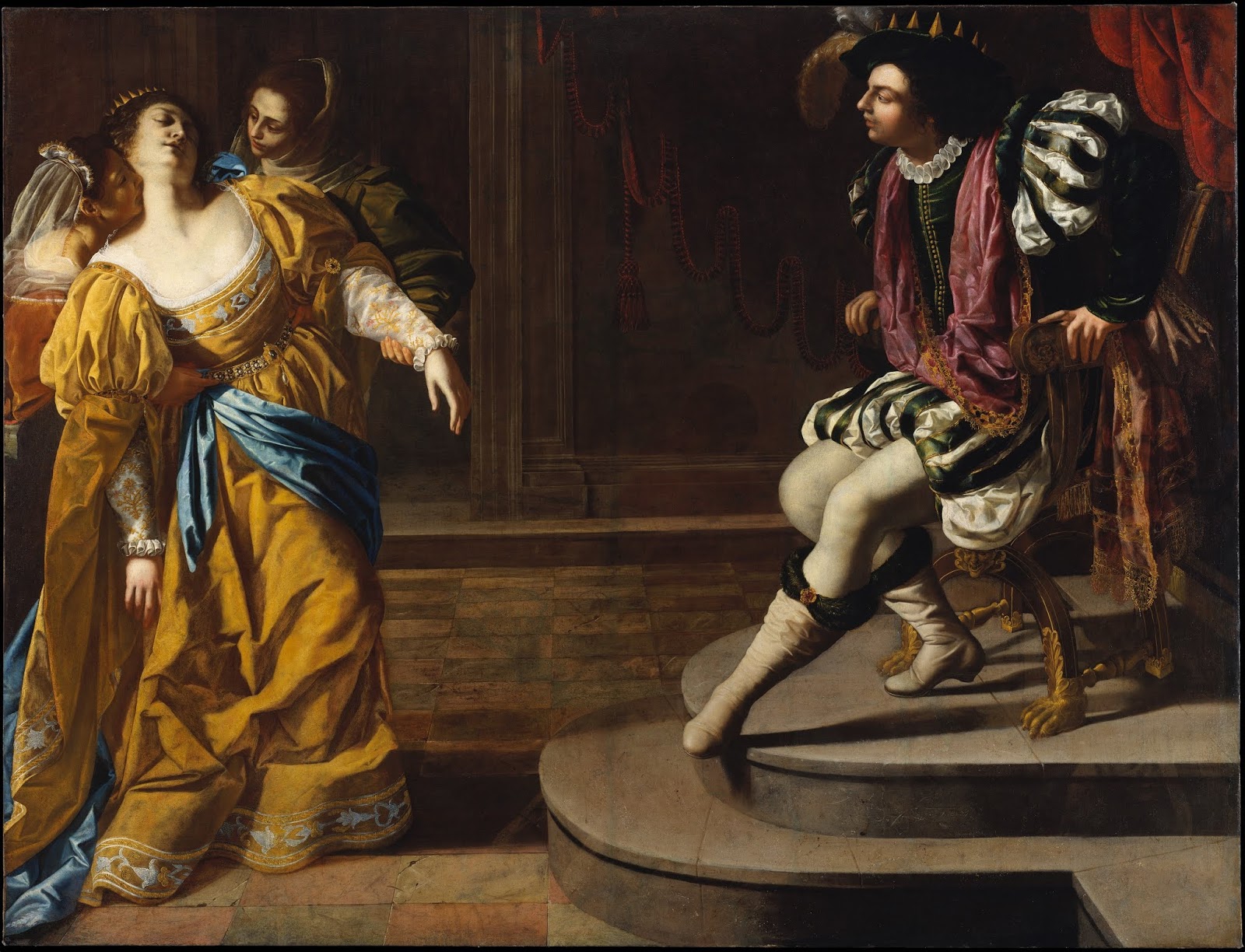
Artemisia Gentileschi, Esther Before Ahasuerus, c. 1630, at the Met Museum

It's Purim again!  That one day of the year you are commanded "to drink until you cannot tell the difference between Haman and Mordechai," i.e. evil and good.

Perhaps that's not an unusual experience these days.  It may feel as though life has become an endless Purimspiel - a farce, a parody, a confusion of facts, and a series of masks of one kind or another on almost everyone.   What to do?  Or more to the point on Purim: "What would Queen Esther do?"

The Book of Esther and the paintings which illustrate this portion of the Bible tug at our conscious.  Would we have the courage to stand up for our rights and the rights of others?  Would we risk death or misfortune speaking out against injustice?

Today is Purim, but everyday brings opportunities to behave like Esther.  These magnificent paintings were created to inspire selfless commitment for a cause:


Aert de Gelder, Esther as a Bride, c. 1684
Alte Pinakothek, Munich 

Rembrandt van Rijn, Esther, Haman and Ahasuerus at Esther's Feast, 1660


Aert de Gelder, Esther and Mordechai, c. 1685, National Museum of Fine Arts
Buenos Aires, Argentina


Aert de Gelder, Esther and Mordechai Writing the Letters for Purim," c. 1684
Rhode Island School of Design Museum of Art, Providence, RI


Happy Spring!  Happy Persian New Year (Nowruz)!  Happy Purim!
Beth New York

aka  Beth S. Gersh-Nesic, Ph.D.
Director and owner
New York Arts Exchange
www.nyarts-exchange.com 


Sunday, March 12, 2017

Purim 2017 - 14 Adar 5777: #BeLikeEsther

Rembrandt van Rijn, Esther Accusing Haman Before Ahasuarus, 1660


Today is Purim, the Feast of Esther, the day to party, get drunk and release our inhibitions behind masks of all kinds.  By now, most people accept that the Book of Esther in the Bible is not true.  We read the story to explain the reason we celebrate Purim and to re-inspire our capacity to do good in the face of powerful forces that seem impossible to defeat.   Queen Esther, you may recall, was asked to be the whistle-blower in order to save the Jews, "her people," by informing her husband that his prime minister, his appointee, scheduled the annihilation of the Jews (herself included) on the 14 day of Adar.  She was fully aware that accusing Haman of wrongdoing might displease the king and his wrath might end her life. Yet in the face of possibly losing her crown and/or her head, she courageously pursued her clever plan. Rather than go straight for the indictment during her first audience with the king, she played it cool and invited him to her private apartment in the palace for an intimate banquet - not once, but twice. Then, like Judith, Esther pleasured her man with food and drink before striking the decisive blow. This fairy tale plot seems based on both archetypal tropes and real experience. Begun as an oral history (possibly linked to the Persian New Year), ir was added to the Hebrew Bible as yet another Wisdom Tale that instructs the Jews about life among those who see them as unwelcome Others.  

Who indeed are the Others in our society today now threatened by government actions? Consider the cost of actions to combat injustice (time, inconvenience, social ostracism). Imagine how difficult it was to #BeLikeEsther and fight for the underdog. Imagine how heroic it is to try.

Here is an old blog post that tells the story of Esther and Purim: 

And here is an excellent article in The Jewish Magazine about Rembrandt and Purim, written by Helen Webberley. http://www.jewishmag.com/121mag/rembrandt-purim-art/rembrandt-purim-art.htm 

Chag Sameach - Happy Holiday - Happy Purim 2017/5777,
Beth 

Beth S. Gersh-Nesic, Ph.D.
Director and Owner
New York Arts Exchange
A division of New York Arts Etc., LLC

Sunday, March 16, 2014

Purim, St. Patrick and the Power of One - Making a Difference Today

Jan Victors, The Banquet of Esther and Ahasurus, 1640s

Chag Sameach!  Happy Holiday!  Today we celebrate the Feast of Esther, also known as Purim, and tomorrow we celebrate St. Patrick's Day or "the wearing of the green."   What do these nearly spring festivals have in common: courage.   That's right, Cowardly Lion from the Wizard of Oz.  Courage.

It isn't enough to ask for courage, one has to perform a courageous act and learn that the power of one decision followed by action to complete the deed is absolutely necessary.  To pass on the work to someone else is not courage.  It's facilitation.   Esther acts, Mordechai facilitates. 


St. Patrick, Church of Christ the Light, Oakland, CA

St. Patrick, the patron saint of Ireland, rid the country of snakes.  Like the Book of Esther in the Bible, it's a story - not necessarily fact.   However, the significance of the narrative is to inspire courage, to demonstrate that acting selflessly to protect the community is the right thing to do.

Both Esther and St. Patrick symbolize the ability for mere mortals to significantly turn the tide for their people - and, most importantly, to choose to act (even in the face of possible death, as was the case for Esther).  This week so many people risked their lives to rescue the victims of the East 116th gas explosion in New York.  They are perfect examples of courage and selflessness.

Be the change you believe in.


Best wishes for Purim and St. Patrick's Day,
Beth New York

aka Beth S. Gersh-Nesic, Ph.D.
Director
New York Arts Exchange
www.nyarts-exchange.com 

Sunday, February 24, 2013

Queen Esther in Art - Celebrating Purim 2013

Edward Millais, Esther, 1865
Private Collection

Today is Purim, the Feast of Esther, which celebrates the courage and clever wiles of a young woman who was asked to save her coreligionists (the Jews) from annihilation. On Purim, one donates to those in need, delivers gifts of sweets to friends and family, and celebrates at a festive meal - with permission to drink until "one cannot tell the difference between Mordecai and Haman."

The story of Esther begins with her predecessor Queen Vashti, who refuses her husband King Ahauserus' summons to appear before his guests at his banquet to celebrate seven years as the ruler of the Persian Empire.  

Edwin Long, Vashti Summoned by King Ahasuerus, 1878
Wikimedia Common

The king's angry advisers insist that her insubordination should not be tolerated. Vashti is sent into exile.


Fra Fillippino Lippi, Vashti Goes into Exile, c. 1480


Lonely without a queen, Ahasuerus calls all the eligible maidens to his palace to compete for his favors. Hadassah, a Jew, answers the call at her cousin-guardian Mordecai's urging, but she changes her name to Esther ("star" in Persian) to mask her ethnic identity. After a year of preparation for her night with the king, she adores herself with little more than her charms.

Théodore Chassériau, Esther Preparing to Meet King Ahasuerus, 1840
Musée du Louvre

Esther's beauty and grace enchant the king. She becomes his bride:

Aert de Gelder, Esther Prepared for her Wedding, 1684


Unfortunately, her happiness hits a snag.  Mordecai  refuses to bow down to the king's prime minister Haman. Again, insubordination has its price. Haman seeks revenge and  arranges for the death of all Mordecai's coreligionists, the Jews, on the 15 Adar (chosen by lots - "purim") and seals the deal with the king's stamp.

Mordecai contacts Esther through a messenger to ask for her intervention.  


Aert de Gelder, Mordecai and Esther, 1685 
(or perhaps, a servant before Esther)
Museum of Fine Art, Budapest

The decision to appear before the king without his permission may result in her death (as Vashti, was exiled - or executed - when she refused to appear before the king at his banquet).  The king will decide Esther's fate. Nevertheless, she acts on behalf of her people and to save herself as well. 

Giovanni Andrea Sirani, Esther Before Ahasuerus, 1630s
Museum of Fine Art, Budapest

I
Esther enters the king's throne room with her servants and finds the king happy to receive her. He encourages her petition and she cleverly invites him to her private chambers for a small banquet in his honor.  The guest list is short: Esther, Ahasuerus and Haman. The meal pleases the king and Haman. She invites them to another dinner party the next day.  

That night the king cannot sleep and has his servants bring his book of chronicles to lull him to slumber. The record of deeds includes Mordecai's report of a plot against the king.  The king calls Haman to his bedchamber to consult on a fitting gesture for "a man who has honored the king."  Crafty Haman assumes the triumphal procession will be for himself.  Instead, Haman ends up leading Mordecai mounted on the king's finest horse through the streets of Susa announcing "this is what becomes of those who honor the king."

Jean-François de Troy, The Triumph of Mordecai. ca. 1736
Metropolitan Museum of Art

The next night, at Esther's second banquet, the king compliments Esther profusely and pledges all manner of gifts to her to express his gratitude. She points to Haman to expose his evil intentions. The king is incensed and leaves the room to cool off.  Haman falls to his knees before Esther to plead for his life. The king returns to see his prime minister touching his wife's hem, which inflames the king's ire to a greater degree. Haman is sentenced to death on the gallows he prepared for Mordecai's public execution on the 15 Adar.


Jan Steen, The Wrath of Ahasuerus, 1668
Cleveland Museum of Art

Mordecai becomes the prime minister in Haman's place. Then the king permits the Jews to defend themselves on the 15 Adar, as he cannot repeal his own law. Mordecai and Esther draft a law to remember this day.  

Aert de Gelder, Esther and Mordecai Writing the Second Letter for Purim, ca. 1685
Rhode Island School of Design Museum of Art, Providence

The celebration of Purim follows this law and inspires courage in the face of circumstances that seem beyond our control.

What can you do to make the world into a better place for everyone?  Think of Esther and give it your best shot.

Chag Sameach - and Happy Oscar parties to you all,
Beth New York

aka Beth S. Gersh-Nesic, Ph.D.
Director
New York Arts Exchange