Monday, May 21, 2018

Transatlantic Conversation with French poet Jean-Luc Pouliquen Live and Online, Tuesday, May 22 at 1:30 PM NY/CT time

Cover by Paul Vilalta, Interior


You are cordially invited to a 

Transatlantic Conversation
with French poet Jean-Luc Pouliquen
moderated by art historian Beth S. Gersh-Nesic

on Tuesday, May 22nd
at 1:30 PM (NY/CT time)

Hosted by 
 at

21 Mead Street, Greenwich, CT 06830

or

join us on Google Hangouts using bethnewyorkarts@gmail.com
(Make a reservation to receive our call by writing to this email address) 

We look forward to seeing you at Byram Shubert Library or online


Bien cordialement,
Beth 

Beth S. Gersh-Nesic, Ph.D.
Director and owner
New York Arts Exchange


Sunday, May 13, 2018

Celebrating Grant Wood on Mother's Day with a NYAE blog repeat -


Grant Wood, Hattie Weaver Grant, 1929


Repeating my Mother's Day 2016 New York Arts Exchange blog post because it was dedicated to my mother, Mildred Gersh - her last Mother's Day with us. Plus the Grant Wood painting is featured in the current Grant Wood retrospective at the Whitney Museum, closing on June 10th (a terrific show).

Happy Mother's Day to you and yours.  This blog post is dedicated to my mother, Mildred Gersh, who gave me a love for art through our many visits to museums.  Thank you, Mom.

Please make visits to museums a frequent and pleasant experience for your family.  Take your children and grandchildren to a museum for a short time - an hour or so.  Not too long.  Just enough time to whet the appetite for more, another day. 

Also, have the children select a reproduction in the bookstore as a souvenir of the trip to the museum. The purchase not only supports the museum, it also extends the experience past the doors of the museum and into one's personal space, one's comfort zone.

I urge you to frame these museum reproductions so that they hang in the child's bedroom, creating a personal connection that will last a lifetime.

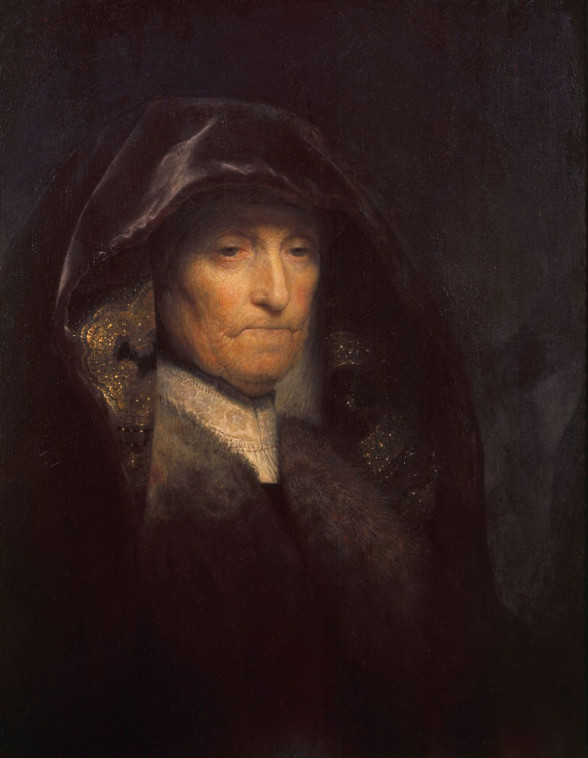
Rembrandt van Rijn, Neeltgen Willemsdochter van Zuytgbrouch. van Rijn, 1629

Rembrandt's mother's face is familiar to us through other works wherein she served as his model.


Vincent van Gogh, Anna Cornelia Carbentus van Gogh, 1888

Almost smiling, Anna van Gogh seems to listen intently.  She provided solace for her son when he was at odds with his father. An artist in her own right, she too studied art and drew plants and flowers in notebooks. 


Andy Warhol, Julia Justine Zavacka Warhola, 1974

Julia Warhola is truly the Mother of Pop Art.  Her charming European script graces most of Andy Warhol's early works, such as the greeting cards and clever books. Examples of her work are currently on view at the Morgan Library in the exhibition Warhol by the Book, which closed on May 15, 2016.


Henry Ossawa Tanner, Portrait of the Artist's Mother, 1897
Philadelphia Museum of Art

Henry Ossawa Tanner's mother, Sarah Elizabeth Miller, was the eleventh child of a slave who sent her children to freedom through the Underground Railroad.  She arrived in Pittsburgh, sponsored by the Pittsburgh Abolitionist Society.  Sarah Miller married Benjamin Tanner, a college-educated teacher and minister who became the bishop of the African Methodist Episcopal Church in Pittsburgh.  Henry Ossawa Tanner was born on June 21, 1859.  The only black student in Thomas Eakins' class at the Pennsylvania Academy of Art from 1880 to 1888, he moved to Paris in 1891, where he enjoyed success as an artist.  He returned to the US for a short time (1893-94) to set up a studio, but was not as well received as in Paris. He returned to France, where he married the Swedish-American opera singer Jessie Olsson and they lived out their lives together. This portrait of his mother may have been painted during a visit to his mother's home or during his mother's visit in Paris.  Another portrait of his mother belongs to the Smithsonian American Art Museum.    


Happy Mother's Day to you and yours - 
Beth New York

Beth S. Gersh-Nesic, Ph.D.
Director and owner
New York Arts Exchange,LLC
www.nyarts-exchange.com.


Tuesday, May 8, 2018

New York Art Week May 2018 and the Rockefeller Sale at Christie's

Pablo Picasso, Girl with a Basket of Flower, 1905

What a weekend we have had, from the Frieze extravaganza on Randall's Island to TEFAF at the Park Avenue Armory at 67th Street and The Moniker Art Fair in Greenpoint,Warehouse in Brooklyn.  A veritable tsunami of art opportunities, wall-to-wall, in each venue.  If you missed any or all of the May Art Fairs this week, click on this article in Hyperallergic that summarizes the best in Manhattan and Brooklyn. 


Paul Gauguin, La Vague (Wave), 1888


However, the most powerful gush of art force has to be the Collection of Peggy and David Rockefeller sale at Christie's, slated for auction on Tuesday evening, May 8th at 7 pm and Thursday morning, May 10 at 10 am.  The expectations already have hearts pounding like the surf in Paul Gauguin's dizzying bird's-eye view of the Le Pouldu. tersely entitled Wave.  This paintings alone will surely fetch buckets of money that Gauguin could have used way back in 1888. (Click on the auction catalog essay for the details surrounding this painting, executed during one of the artist's lengthy sojourns in Pont-Aven, Brittany - January through October, preceding his famous roommate kerfuffle with Vincent van Gogh that ended abruptly just before Christmas.)


Claude Monet, Nyphéas en fleur (Waterlilies in Flower), c. 1914-17

Another tidal wave of cash will definitely come from the late Monet Waterlilies in Flower, completed before he started the ambitious waterlily murals on view at the Musée de l'Orangerie, virtually on view right  here.  No doubt this WWI period piece shows off  this Impressionist's evergreen range while in his 70s.  His youthful exuberance teeters on the cusp of abstraction.


Pablo Picasso's Girl with Basket of Flowers (once called La Fille au Pavé) at
Christie's, May 2018


Still - my bets are on Picasso's Girl with a Basket of Flowers, painted during the autumn of 1905, as the all-out top seller for the whole auction.   This work belongs to the year Fernande Olivier moved into Pablo's pad in the squalid Bateau Lavoir.  Similar in sobriety to Boy with a Pipe, 1905, wherein a serious young man dressed in a worker's blue outfit is crowned with roses (a gesture that turned the mundane into the otherworldly), this careworn young lady also wears her professional attire - nothing.  Clutching her straw basket brimming with red smudges of some sexually suggestive blooms (poppies, roses, anemones - the tears of Venus as she mourned the death of Adonis), we note all the obvious absences: clothes, context and individual identity.  Who is she in the painting? She is a model, pure and simple, and one who probably beds the artist between poses.  She is young, she is  pretty, but she is not happy.  Rather, she seems bored or just dog tired.  She is tired of holding the basket and she is tired of the life she is forced to live.  Picasso knew Manet's famous painting of a prostitute Olympia, wherein the flowers were handed to her maid by the one who entered her chamber (you).  Picasso's poor street urchin, identified in Jean-Paul Crespell's book Picasso and His Women (1967)  as Linda La Bouquetière, can't afford this luxury.  She was a local flower seller who seems to be no more than 16 years old.  Picasso's choice of expression inspires sympathy.  Like Olympia and all of her sisters, this child, who anticipates womanhood in full flower, will age quickly, like the rosy red petals in her basket.  Her oddly aged face seems to predict this outcome.

I
Henri Matisse, Odalisque Couchée aux Magnolias, 1923


In contradistinction, Henri Matisse celebrates sensuality and sexuality in his Odalisque Reclining Among the Magnolias  though the addition of flowers that suggest an erotic perfume in the midst of seductive surrender. Here lies languid pleasures in sultry climes, a feast for the artist who shares his delight in the female body.

So - have your picked your favorite?  Virtual paddles ready for the BIG NIGHT.  
Turn in online to witness this inevitable historic occasion.

And may the best bidder win!
Cheers,
Beth

Beth S. Gersh-Nesic, Ph.D.
Director and owner
New York Arts Exchange, LLC


Thursday, March 29, 2018

Christina Thomas: Healing Through Art

Christina Thomas, "Hope" Prayer Box, 2017, featured in the Bosom Bodies exhibition, 2017

Spring is finally here!  And with the warmer days, we plant seeds in our gardens to bring us the  beauty of flowers and healthiness of fresh food.  In short - we not only hope for better days ahead after winter, we make it happen with our own creative forces.

Artist Christina Thomas knows this too well and practices sowing her seeds of hope through her art. She began with herself and then she spread her "power of personal freedom" to others in need of healing, inspired by Dr. Winston Collins' book.  What else inspired her?  Here is her story: 

Christina Thomas, Untitled, 2017


Beth: When did you decide to dedicate yourself to developing the artist within yourself?

Christina: I have been painting since I was 11 as an emotional outlet. After a severe flair up with Multiple Sclerosis.  My body and spirit were broken.  Painting became a therapeutic endeavor sculpting tissue into text.  This was the way of healing the agility of my fingers but not my soul.  I found myself in a very dark place and a spiritual journey was set before me.  I began working on a series called Seven Ways to Sunday.  It was based on the sermons I was hearing each Sunday.  I had been led to a community of believers.  They taught me that God was love.  Love is for everyone.  The shame and guilt began to melt away.  My art became less about escape and began to heal what was broken within.

Beth: What were the circumstances? 

Christina: The circumstances I had to overcome were the fight I had within myself.  I was struggling to be authentic.  I was struggling with past trauma.  I was dealing with kidney failure and the terminal diagnosis that accompanied it.  My marriage was beginning to fall apart.  I was also dealing with living with Multiple Sclerosis.  These circumstances made me adapt how I articulated my truth on the canvas.  My muse was the pain because words at times were too painful to vocalize. The brush allowed me to be present in the stroke and acted as a guided meditation.  Each stroke quieted my mind.

Beth: How did you find time?

Christina: At that time I was teaching art to the developmentally disabled.  It was an atmosphere filled with love.  My students took care of me and fed the part of my soul that was so empty.  I would work when I was inspired and also I was great at working on a deadline.  I made working a priority on a regular basis.


Christina Thomas, Untitled, 2017


Beth: Where did you work?

Christina: I painted on flat surfaces, my lap, the floor included.  I was an intern at the Pat Hearn Gallery in Chelsea during my undergrad.  I began working as a medical receptionist in dermatology and the remainder of my career as a cardiology technician.  At this point I was trained to do wound care.  Wound care was my inspiration for the way I sculpted my text on the canvas and using ink to add color.   Packing of the wounds and the different types of dressing allowed a different layer of my work to emerge.

Beth: Did you receive encouragement from your family or friends?

Christina: In the beginning my art was seen by some as a hobby.  It began to become recognized as I had exhibitions and grew more dedicated myself.  Friends always gave me their full support.  My first solo exhibition was filled with friends and family.  All I wanted was my art to have a life outside of my bedroom. 

Christina Thomas, Prayer Box, 2017, featured in Art Above the Sofa, April 28-30, 2017

Beth: Who are the greatest influences on your work?

Christina: God is the greatest influence on my work.  My work would not be possible without his grace. I have almost died from medical complications on more than one occasion.  Each time I made it through I had a new understanding that I had a purpose.  Having recently been gifted a kidney and no more dialysis I have been born again.  My new collection of art and the pieces leading up to it mark a change in my spirit.  Today my art is about gratitude.  
My grandparents are also an influence.  Knowing what they lived through and living in a time when "Back Lives Matters" is chanted in the streets is a strong juxtaposition to where African Americans have come from.  My grandfather was a doorman and my grandmother a maid and the both took pride in their work. They were diligent and responsible in every task.
The artists that moved me the most were Frieda Kahlo and Jean-Michel Basquiat.  Kahlo endured a long medical crisis and I could identify with her.  She embraced her art in such a unique way by drawing on her body cast.  Her art was her narrative.
I am equally in awe of Basquiat and his use of text.  I loved the way he made you read his story.  He drew your attention to it by crossing out letters.  His art reflected his claim of being a King in his crowns.  
Both artists greatly influenced my thinking and me.


Christina Thomas, Prayer Box, featured in Bosom Bodies exhibition, October 2017

Beth: What are the greatest influences on your work?

Christina: The greatest influences on my work are my life experiences.  My illness has made me see life through different glasses.  It is in the healing that the work evolves.  Other influences have been the issues of Black Lives Matter, the Environment, Domestic Abuse and organ donation.  I am influenced by my personal world and the world at large.

Beth: You have discussed art and healing, art and adversity – please tell us more: How does art play a role in your healing process?

Christina: Art is the place where I release feelings freely on canvas.  Painting is a place where my mind can rest.  It is a place where I can laugh and a place where I can cry.   The strokes and colors I choose allow me freedom and, for a moment, the control that I do not have over my body, or the physical, stops.  My focus is confined to 16 x 20 inches and the primary colors. Creating a cohesive or a chaotic quality gives me the power of choice.

Beth: Does it express your sense of healing?

Christina: Art does not always express a sense of healing but willingness.  It can be the beginning of peeling the onion on a larger issue that leads to healing.  The expression of healing is picking up the brush, letting the fear go and creating.  Creating just for you as though no one is looking.  My sense of healing can be felt in the confident strokes, but more so in the times when I use a spoon to apply colors because the MS will not allow me to use a brush. Healing takes time.

Beth: What does “art and adversity” mean to you?  Please tell us about your philosophies.

Christina: I have faced adversity and art was my way out.  Art was a world I could escape to.  I was able to get lost in the colors and the canvas.  Emotion and concentration helped me to find balance between hue and shape. Art was my bridge.  It seemed as though I was always surrounded by adversity.  Art served to get me from point A to B.  It was my constant. As a patient in the hospital I would create in my mind and on home dialysis I would paint during that treatment.  Art has been necessary for my survival and has anchored me to reality.  My paintings tell my story and show the path through my adversity.  The art was God’s gift to me. The art was God’s life preserver.  So far it has worked time and time again.

May Christina Thomas' work and her words be an inspiration to you all - hope, create and share  your love through your art.

To learn more about Christina Thomas' work, please contact her directly at ct74249@gmail.com  

You can also view her work in person at the Art Tour International Magazine exhibition, opening on April 28th.  For more information about the exhibition and Christina's work in the exhibition, please contact the curator Viviana Puello through Art Tour International Magazine.


Best wishes for Passover and Easter,
Beth

Beth S. Gersh-Nesic, Ph.D.
Director and owner
New York Arts Exchange, LLC
www.nyarts-exchange.com
Twitter: @BethNewYork


Wednesday, March 21, 2018

Jean-Luc Pouliquen and Beth Gersh-Nesic's Transatlantic Conversation on Art and Poetry


Press Release
Transatlantic Conversation: About Poetry and Art
Conversation Transatlantique: autour de l’art et de la poésie
1 March/Mars 2018

American art historian/critic, Beth Gersh-Nešić and French poet/literary critic  Jean-LucPouliquen share a deep appreciation for the poet/critic André Salmon, who was the close friend of poet/critic Guillaume Apollinaire and artist Pablo Picasso.  From both sides of the Atlantic Ocean, they reminisce about the beginning of the twentieth century when Salmon participated in the great adventure Cubism.  Transported by their conversation, the two travel down the road of time to the most recent contemporary expressions.  Within this exchange, they ask each other about the current state of affairs for poetry and art in Europe and in the United States, how the new forms of communication spread the word about the arts, and how these art forms are shared from one culture to another.  As they acknowledge the globalization of art, they conclude with the statement that once again the arts try to “do good,” as was their purpose in the past.

About the Authors

Beth Gersh-Nešić, Ph.D. is an art historian and the director of the New York Arts Exchange, an arts educational service which offers art tours and lectures in the New York area.  She specializes in Cubism and the art criticism of the period. She has published on the poet/art critic André Salmon, a close friend of Pablo Picasso, Guillaume Apollinaire and Max Jacob, and numerous modernist and post-modern artists. She teaches art history at Purchase College in New York.

Jean-Luc Pouliquen is a poet and literary critic. Collections of his poetry have been published in Mémoire sans tain (One-Way Memoir) and Célébrations (Celebrations). He is the author of several interviews dedicated to poetry, such as Fortune du poète (The Poet’s Fortune) with Jean Bouhier and Sur la page chaque jour (On the Page Every Day) with Daniel Biga, as well as essays.  He wrote the books Gaston Bachelard ou le rêve des origins (Gaston Bachelard or Dreaming of Origins), and Georges Pompidou, un président passionné de poésie (Georges Pompidou, a President Passionate about Poetry).  He regularly leads poetry writing workshops.

In English: A New York Arts Exchange Publication

Cover Design: Paul Vilalta's painting Interior


Wednesday, March 7, 2018

Last Call: Carla Rae Johnson's Séance Series at WCC Art Gallery through Sunday, March 11


Carla Rae Johnson, Anne Frank and Albert Schweitzer in the foreground;
Georgia O'Keeffe and Galileo Gallilei in the background

Carla Rae Johnson: Séance Series, currently on view at the Westchester Community College's Fine Arts Gallery, will close on Sunday, March 11th.  This is an excellent exhibition of beautifully wrought works of art and intellectually stimulating iconography.  Professor Johnson asks the question: "What if Emily Dickinson met Marcel Duchamp or Bessie Smith met Ludwig von Beethoven or Anne Frank met Albert Schweitzer or Frida Kahlo met Franz Kafka or Audre Lorde met Abraham Lincoln or Hildagard von Bingen met Herman Melville or Georgia O'Keeffe met Galileo Galilei?"


Carla Rae Johnson, Bessie Smith and Ludvig van Beethoven, at WCC


The artist explains her work:
STATEMENT

"My sculpture is directly connected to ideas and often addresses issues of social, political, and cultural import.  As an artist, I find the most challenging forms and concepts at the intersection of the visual and the verbal.   Begun in 2000, The Séance Series suggests imagined meetings between unlikely pairs; creative individuals that never met during their lifetimes:   Emily Dickinson with Marcel Duchamp, Hildegard of Bingen with Herman Melville, Bessie Smith with Ludwig van Beethoven and Audre Lorde with Abraham Lincoln."

Carla Rae Johnson, Audre Lorde and Abraham Lincoln


"Each of the pairs in The Séance Series plays a game.  Bessie Smith and Ludwig Van Beethoven meet at the piano.  Lorde and Lincoln play 'bridge.'  This bridge is not a card game, but a physical, symbolic span across an obstacle.  I think Audre Lorde would have confronted Lincoln on issues of race, power, and privilege, so it is Lincoln who must build the bridge.  Not a straightforward crossing, this is a difficult, jagged transition; composed of huge steps, twists, inclines, and internal tensions.   At the top of the center of the crossing is a 'spirit-level' symbolic of the quest to equalize and create a more level ground.  Beneath the bridge sits the 'house.' Emblematic of the existing social structure, 'the master's house,' is the obstacle that must be bridged with understanding and common ground, level ground, so that together Lorde and Lincoln can dismantle its walls and work toward a just future."


Carla Rae Johnson, "Please Touch Vesuvious" from Emily Dickinson and Marcel Duchamp

On her "Please Touch Vesuvius," Carla Rae Johnson continues: "Asked to design an invitation in 1947, Duchamp submitted a rubber cast of a woman’s breast adhered to black velvet and titled Please Touch  Emily Dickinson, in several of her poems compares her explosive poetic powers (and, perhaps, some smoldering angers) to the natural force and heat of a volcano.  The juxtaposition of breast and volcano creates associations rich in visual/formal relationships, powerful contrasts, and gender role reversals."


Carla Rae Johnson, Emily Dickson and Marcel Duchamp

Carla Rae Johnson, Emily Dickinson and Marcel Duchamp


Carla Rae Johnson, Hildagard of Bingen and Herman Melville

Carla Rae Johnson, Frida Kahlo and Franz Kafka


NB: WCC Fine Arts Gallery is closed today due to inclement weather. Therefore, please check the campus website for the hours when the gallery is open after the storm.  Normal hours are: Tuesday-Saturday 10 am to 3 pm; Thursday from 4 - 6 pm.

For information about the gallery and "Cultural Events," email  paula.rubenstein@sunywcc.edu  or call 606-6567. 

Westchester Community College campus is located at 75 Grasslands Road, Valhalla, NY 10595.  The WCC entrance off of Knollwood Road leads straight to the parking area next to the Fine Arts Building wherein you will find the gallery right next to the entrance.

Take care in the snow,
Beth

Beth S. Gersh-Nesic, Ph.D.
Director and owner
New York Arts Exchange, LLC

Sunday, March 4, 2018

Women Impressionists at Byram Shubert on Thursday Evening, March 8th at 7 PM

Mary Cassatt, Spring: Margot Standing in the Garden, 1900
Metropolitan Museum of Art


Please  join us to celebrate International Women's Day with a lecture and discussion about:

American and French Impressionist Women Artists

Lecturer: Beth S. Gersh-Nesic


21 Mead Avenue, Greenwich, CT 06830

at 7 PM

Free Admission


I look forward to seeing you there!

Best wishes for Women's History Month -
Beth

Beth S. Gersh-Nesic, Ph.D.
Director and owner
New York Arts Exchange, LLC