Showing posts with label Picasso. Show all posts

Saturday, February 17, 2024

Last Call: Picasso in Fontainebleau, closing today Feb 17 for general public, Feb. 19 for MoMA members

Pablo Picasso, Spanish, 1881–1973
Three Musicians, Fontainebleau, summer 1921
Oil on canvas
6' 7" x 7' 3 3/4" (200.7 x 222.9 cm)
The Museum of Modern Art, New York. Mrs. Simon Guggenheim Fund
©2023 Estate of Pablo Picasso/Artists Rights Society (ARS) New York

From July to September in 1921, Picasso rented a villa for himself, his Russian ballerina wife Olga Khokhlova, and their five-month-old son Paul Joseph (“Paolo”) in the charming village Fontainebleau, about 35 miles from Paris, best known for its glorious, eclectic château, dating back to the 12th century. In the adjacent garage, fitted out as a studio, Picasso created four gigantic masterpieces: Three Musicians (two versions painted simultaneously) and Three Women at the Spring (two versions, one painting and one red-chalk drawing). These 6-foot works towered over 5 foot-4 inch Picasso in this narrow space, generating an enigmatic puzzle for future Picasso scholars: What can we glean from Picasso’s eclecticism during this summer in Fontainebleau?

Pablo Picasso, Spanish, 1881–1973
Three Musicians, 1921
Oil on canvas
80 1/2 × 74 1/8" (204.5 × 188.3 cm)
The Philadelphia Museum of Art. A. E. Gallatin Collection, 1952©2023 Estate of Pablo Picasso/Artists Rights Society (ARS) New York


Willing to take on the challenge and contribution to Picasso 1973-2023: The Fiftieth Anniversary, New York’s Museum of Modern Art brought these four significant works together for the first time since they left Picasso’s Fontainebleau studio in 1921. Blanchette Hooker Rockefeller Senior Curator of Painting and Sculpture Anne Umland and her assistants Alexandra Morrison and Francesca Ferrari examined the works diligently, and then had them installed with other Picasso works completed at the same time in order to study this pivotal period in this artist’s very long and extraordinarily productive career. Their query is: What was Picasso thinking?  We have, on the one hand, his late Cubist style for Three Musicians and, on the other, his “Ingres-esque” classical style for the Three Women at a Spring. What should we take away from this disparate combination?


Pablo Picasso, Spanish, 1881–1973
Three Women at the Spring, Fontainebleau, summer 1921
Oil on canvas
6' 8 1/4" x 68 1/2" (203.9 x 174 cm)
The Museum of Modern Art, New York. Gift of Mr. and Mrs. Allan D. Emil
©2023 Estate of Pablo Picasso/Artists Rights Society (ARS) New York


First, let’s consider the brilliant exhibition Picasso in Fontainebleau. We enter into a huge gallery where we see numerous works of art produced within the few years leading up to the summer of 1921. Several come from the Museum of Modern Art’s collection, owner of Picasso’s greatest creations, most notably, Les Demoiselles d’Avignon (1907). Then we walk through a small, narrow gallery that features ghostly reproductions painted on the walls giving us a feeling for the dimensions inside Picasso’s studio-garage, 20 x 10 feet. From there we emerge into a very large gallery which displays the two versions of the late Cubist Three Musicians (from MoMA and from the Philadelphia Museum of Art), facing each other on opposite walls, and the two versions of his classical Three Women at the Spring, which face each other as well. The musicians are male and the women at the spring are – well, you know. 


Installation view of Picasso in Fontainebleau, Museum of Modern Art, New York, October 8, 2023-February 17, 2024. Photo: Jonanthan Dorato


It’s an intriguing ensemble of characters. The musicians seem lighthearted as they entertain us with their silent concerts. They belong to the traveling burlesque Commedia dell’Art tradition, dating back to the Italian Renaissance. Their masked faces peep out at us, eager to attract our attention. Their bodies are flat interlocking planes of solid colors: bright white, orangy red, pale green, dark blues, gray, and light brown hues against a chocolate brown background in the New York version and grassy patterned green background in the Philadelphia version. All six figures seem to exude a bit of rambunctiousness. The push-pull of the colors that share parts of their interconnected bodies produces a rhythmic quality. These guys are rockin’. The Pierrots are tooting away on clarinets or Spanish tenoras. The New York Harlequin strums a guitar, while the New York monk sings. The Philadelphia Harlequin pauses from fiddling his violin, bow in his left hand, as his neighbor, the other monk, holds his cup in his right hand and the concertina on his lap with the left. In this MoMA room they are showing off their manly skills to impress six scantily-dress ladies preoccupied with drawing water from a spout.


Pablo Picasso, Spanish, 1881–1973
Three Women at the Spring, 1921
Red chalk on canvas
78 3/4 × 63 3/8" (200 × 161 cm)
Musée National Picasso-Paris. Dation Pablo Picasso
©2023 Estate of Pablo Picasso/Artists Rights Society (ARS) New York


None of the Women seem to be listening to these hardworking Musicians. They are lost in conversation, too absorbed in their task and themselves to pay attention to anyone else, including us, their audience.  In comparison to Three Musicians, Picasso’s Three Women at a Spring imposes a somber note among the jazzy razzle-dazzle of their male companions. Quiet and contained within their earthy umber background, these colossal bodies, dressed in grayish-white chitons, seem more like 5th century BC Greek columns than lithe ancient Greek sculptures from the same era. They are zoftig and majestic, similar to figures in 17th century French Classicist Nicolas Poussin’s Et in Arcadia Ego, which Picasso must have studied in the Louvre. Picasso’s 20th century version of classical female figures whisper while their male counterparts, six Musicians in this gallery, bray. The women own their space with timeless, monumental stability: salt of the earth, instead of fearsome femme fatales. The musicians seem to represent an ephemeral reality, the fairytale land of theatrical performance.


Nicolas Poussin, Et in Arcadia Ego, second version, 1628, Musée du Louvre.
Source : Wikipedia. Public Domain


In short, we register an agon here between the flimsy “cubiçant” guys and the substantial “classical” gals reunited in this physical space but perpetually at odds with each other psychologically as they act out two different modes of human interaction. They're Picasso's Kens and Barbies - the Great Divide between the sexes. Nothing has changed since these huge canvases left Picasso’s Fontainebleau garage over a century ago. The four groups of only men or women still huddle on the sidelines during this Big Dance of life.


Pablo Picasso, Spanish, 1881–1973
Studies, 1920-1922
Oil on canvas
39 3/8 × 31 7/8" (100 × 81 cm)
Musée National Picasso–Paris. Dation Pablo Picasso
©2023 Estate of Pablo Picasso/Artists Rights Society (ARS) New York


Also, these works offer some insight into Picasso’s incipient midlife crisis, caught between his old bohemian life with his Montmartre bodies and his new embourgeoisement with demanding wife Olga and irresistibly adorable Paolo. The late great art historian Theodore Reff interpreted the tres amigos as a wistful backward glance toward Picasso’s early days in Paris when Picasso’s Gang met every day in Montmartre or Montparnasse. This analysis sounds quite convincing since Picasso would turn 40 in October, a significant age for most, usually a time to reevaluate past accomplishments and worry about the ultimate retirement in the not-too-distant future. Death, by the way, is definitely present in Three Musicians. Here’s the scoop on that interpretation.


Installation view of Picasso in Fontainebleau, Museum of Modern Art, New York, October 8, 2023-February 17, 2024. Photo: Jonanthan Dorato


In both versions of  Three Musicians we see Harlequin (a ne’er do well ladies man), Pierrot (a sad-sack clown), and a monk. Theodore Reff believed each character alluded to Picasso and two members of his famous entourage: Picasso as his alter-ego Harlequin, the poet/novelist/critic Guillaume Apollinaire as Pierrot, and poet/critic/artist Max Jacob as the monk. In the MoMA version we see parts of a dog under Pierrot’s chair on the extreme left. This Anubis-like creature symbolizes death. Apollinaire died from “Spanish Flu” on November 9, 1918. That summer of 1921, Max Jacob retreated to a Benedictine monastery in St. Benoit-sur-Loire, hence the brown triangle (“hood”) atop a brown rectangle with depicted rope belt in the Philadelphia version and without a belt in the MoMA version. 


Installation view of Picasso in Fontainebleau, Museum of Modern Art, New York, October 8, 2023-February 17, 2024. Photo: Jonanthan Dorato.

Other things to notice: Pierrot wears his signature white clown outfit and Harlequin wears his signature diamond pattern jumpsuit. Significantly, the colors for this Harlequin’s pattern are red, black, and green, the colors of the Spanish flag, which reference Picasso’s nationality. Also in both works the figures wear masks and the clothes are reminiscence of the costumes and sets Picasso designed for the Ballets Russe production of Pulcinello in 1920. We imagine these figures are performing on stage as we stand in the front row.  We also notice that in the Philadelphia version Pierrot’s clarinet contains a human profile, perhaps a direct reference to Apollinaire.


Cover photo of Annie Cohen-Solal’s book
 

Annie Cohen-Solal’s book and exhibition A Foreigner Called Picasso  points out that Picasso’s identification with Harlequin references his sense of alienation. Harlequin is a stock character in Commedia dell’Arte, whose antics come from the position of an outsider, perhaps a drifter. He causes trouble with his mischievous schemes. He may be The Fool in the Tarot card deck. His character seduces Pierrot’s wife, Columbina, behind Pierrot’s back, which adds sexiness to Harlequin’s attributes, and melancholy to Pierrot’s. No doubt Picasso identified with this flattering aspect of Harlequin, the irrepressible tombeur (ladies’ man). 


Installation view of Picasso in Fontainebleau, Museum of Modern Art, New York, October 8, 2023-February 17, 2024. Photo: Jonanthan Dorato


Picasso’s late Cubist vocabulary continues the artist’s collage aided planar vocabulary developed during the so-called Synthetic Period of Cubism (1912-14) and connects these paintings to his studio in the Bateau Lavoir, where he created his harlequin paintings during his Rose Period (1905-1906) and Les Demoiselles d’Avignon in 1907, the masterpiece that introduced his future Cubist planarity, passage, and geometricity.  From my perspective, Three Musicians, painted together in one studio, might represent his Parisian tertulia, who shared his jokes and pranks, which he performed in his Synthetic Cubist’ collages. These visual and linguistic puns were decoded for us in Elizabeth Cowling and Emily Braun’s illuminating exhibition Cubism and the Trompe l’Oeil Tradition, at the Metropolitan Museum of Art, another contribution to the Picasso 1973-2023: Fiftieth Anniversary celebration.


Pablo Picasso, Spanish, 1881–1973
The Spring, 1921
Oil on canvas
25 3/16 × 35 7/16" (64 × 90 cm)
Moderna Museet, Stockholm. Gift of Grace and Philip Sandblom
©2023 Estate of Pablo Picasso/Artists Rights Society (ARS) New York


Jean-Auguste-Dominique Ingres, La Source (The Spring), 1850
Source: Wikipedia. Public Domain 


Three Women at the Spring, on the other hand, continues Picasso’s neoclassical “Ingres Period” with its emphasis on sculptural expression. This exploration of volumetric forms seems to chisel out the face, body, massive hands, columnar pleats, and blocks of stone arranged around the standing and sitting figures. We can see the same classical robustness in Picasso’s Studies (1920-1922) and other portraits of his ballerina wife Olga Khoklova, whom he married on July 12, 1918.  


Installation view of Picasso in Fontainebleau, Museum of Modern Art, New York, October 8, 2023-February 17, 2024. Photo: Jonanthan Dorato


Picasso’s pivot to a mannered classicism began in 1914 with his unfinished (?) painting, The Painter and the Model. The following year he delicately drew in pencil several Ingres-esque portraits of his friends and dealers, including Apollinaire and Max Jacob. He hadn’t abandoned Cubism, he simply added to his arsenal of visual expressions that seemed appropriate for his state of mind and spirit (son esprit).  In 1915, his eerily smiling Cubist Harlequin, also in MoMA’s collection and included in this exhibition, seems to mark his transition from a life with his beloved Eva Gouel (his muse during the Cubist years) and without. She died in December 1915. This period of her illness (cancer or tuberculosis) caused this normally resilient artist much anxiety (described his letter to Gertrude Stein at the time).


Installation view of Picasso in Fontainebleau, Museum of Modern Art, New York, October 8, 2023-February 17, 2024. Photo: Jonanthan Dorato


In a 1923 interview Picasso explained: “If an artist varies his mode of expression this only means that he has changed his manner of thinking, and in changing, it might be for the better or for the worse. The several manners I have used in my art must not be considered an evolution, or as steps toward an unknown ideal of painting.  All I have ever made was made for the present and with the hope that it always remains in the present.” (Picasso on Art, edited by Dore Ashton, Da Capo Press, 1972, p. 5)


Installation view of Picasso in Fontainebleau, Museum of Modern Art, New York, October 8, 2023-February 17, 2024. Photo: Jonanthan Dorato

Anne Umland observed: “these four imposing works lie at the heart of Picasso in Fontainebleau, which delves into a strikingly contradiction-filled moment when Picasso seemed intent on demonstrating how in his art, and in his conception of the tradition of painting more broadly, classicism and cubism, the academy and the avant-garde, the historical past and the contemporary present, were dialectically related and inexorably linked.”


Olga Khokhlova in Picasso’s studio, Montrouge, Spring 1918.
Photographer: Pablo Picasso (?) or Emil Delatang(?)


This phrase “dialectically related and inexorably linked” holds the key to our appreciation of this extraordinary artistic endeavor.  Rarely, if ever, do we see an artist work simultaneously in two distinctly different and contradictory styles, one flat and the other in illusory three-dimensions. Picasso clearly mastered each style at this point in his career but had also reached a crossroads that needed processing before achieving some resolution. When Marie-Thérèse Walter entered his life in January 1927, Picasso seemed to have found his synthesis, allegedly motivated by this blonde, athletic teenager. That may or may not be true, but we can’t help notice Picasso changed his style and dog (according to Dora Maar) every time he changed his mistress. The next Picasso period blends his Cubist criteria with his curvaceous figurative classicism to form his signature “Surrealist” style, perhaps his most iconic visual expression when we think of the word “Picasso” as a noun, an adjective, and a brand.

The conundrum of Picasso’s four Fontainebleau masterpieces created side-by-side in his modest garage-studio may have met its match in MoMA’s ambitious exhibition.  Or, it may remain elusive, as much of Picasso’s work continues to be. Although fifty years have passed since Picasso’s death on April 8, 1973 and 122 years have passed since Picasso’s first exhibition at Ambroise Vollard’s gallery on the rue Lafitte in June 1901, the protean complexity of Picasso never ceases to challenge and amaze. He was, and remains, one of greatest artists who graced this planet. And we have not heard the last word on his Fontainebleau period, nor any other period, guaranteed.

***

For more information about MoMA’s Three Women at a Spring, please watch this video, and their Three Musicians, please watch this video.  Both videos recount the histories of paintings as physical objects. Fascinating!

The catalogue for Picasso in Fontainebleau, featuring 15 essays, 239 color illustrations is available through MoMA and other booksellers online.


c


Saturday, February 10, 2024

Last Call - Picasso at Gagosian, closing today!


Photograph by Beth S. Gersh-Nesic
Pablo Picasso, Harlequin, 1901, Metropolitan Museum of Art
Pablo Picasso, Yo - Self-Portrait, 1901, Museum of Modern Art
Pablo Picasso, Head of a Fool, 1905, Private Collection

 
A Foreigner Called Picasso
Gagosian Gallery
522 West 21st Street

Curated by Annie Cohen-Solal and Vérane Tasseau

Closing February 10th

For more information, please visit the website:

Available online


Friday, January 20, 2023

Last Call: Cubism and the Trompe L'Oeil Tradition at the Met, closing January 22


Georges Braque, French, Argenteuil 1882–1963 Paris 
Violin and Sheet Music: "Petit Oiseau." Paris, early 1913 
Oil and charcoal on canvas 28 × 20 1/2 in. (71.1 × 52.1 cm) 
The Metropolitan Museum of Art, New York, 
Promised Gift from the Leonard A. Lauder Cubist Collection


"Because of his family's background, the painter Georges Braque . . .  belongs to that class of rich artisans and great entrepreneurs.  His family painted, or had others paint for them, almost all the interior walls erected in Le Havre at the end of the last century.  I am convinced that Georges Braque owes to this ancestry some of his most brilliant qualities.

One day he was discussing with Picasso the inimitable in painting, a favorite theme of modern artists.  If one paints a gazette in the hands of a personage, should one take pains to reproduce the words PETIT JOURNAL or reduce the task to neatly gluing the gazette onto the canvas?  They went on to praise the skillfulness of housepainters who extract so much precious marble and wood from imaginary quarries and forests.

Naturally, Georges Braque provided useful explanations, not sparing the juicy details of the craft.

He went on to say that a certain steel comb that helps housepainters achieve false marble and false wood can be run along a painted surface to achieve a simulation of veins and marbling.

We might smile at the seriousness brought to this type of discussion, because we might harbor the faintest prejudice and would not want to heed certain benefits that the artist finds, as he leans toward the beauties of the artisan's work. . . . 

In short, Picasso and his guests agreed on the use of the housepainter's comb, but note that no one intended, however, to imitate these skillful artisans.

This is of extreme importance.  An artist grows thinking about many things. He may even desire equipment that seduces him, but that's enough. He does not have to appropriate either the tool or the process.  It is better to do what one of his own did (the painter [Louis] Marcoussis) - imitate the imitation."

--André Salmon, "The Fable of the Tin Fish," in Young French Sculpture (written in 1914 and published in 1919), translated into English by Beth S. Gersh-Nesic in André Salmon on French Modern Art (Cambridge University Press, 2005)


Pablo Picasso, Spanish, Malaga 1881–1973 Mougins, France 
Pipe and Sheet Music, 1914 
Cut-and-pasted printed wallpapers, wove papers, gouache, graphite, and chalk on paper 
20 1/2 × 26 1/2 in. (52.1 × 67.3 cm) 
The Museum of Fine Arts, Houston, Gift of Mr. and Mrs. Maurice McAshan (69.11)


Dear friends,

The Metropolitan Museum's groundbreaking exhibition Cubism and the Trompe l'Oeil Tradition, on view since October 20, 2022, will close on Sunday, January 22, 2023. It's a revelation, and it's beautiful!  Moreover, no reproductions can equal the experience or the impact of this extraordinary curatorial effort that explains one of the least understood and most significant aspects of the Cubist movement, especially its collage. In essence, we learn that one of the oldest ways of judging artistic merit, the ability to copy nature to the degree that it fool's the eye (in French, tromper -  to deceive; l'oeil - the eye), played a significant role in the Cubist works by Pablo Picasso, Georges Braque and Juan Gris. Since most of us look upon Cubism as the threshold to abstraction, the opposite of verisimilitude, the news that these Cubists assiduously studied and parodied trompe l'oeil may come as a shock. In the hands of the two brilliant art historians and curators Emily Braun, Distinguished Professor of Art History, CUNY Graduate Center and Hunter College, and Elizabeth Cowling, Professor Emerita, Edinburgh University, with the previous collaboration of the former curator of the Leonard A. Lauder Collection, Rebecca Rabinow, currently the director of The Menil Collection in Houston, Texas, we learn that Picasso, Braque and Gris (art dealer Daniel-Henri Kahnweiler's principal stable of artists) invented this peculiar visual language larded with visual jokes, puns, and codes to delight each other as it stoked their competitive natures.

Georges Braque, French, Argenteuil 1882–1963 Paris 
Fruit Dish, Ace of Clubs, 1913 
Oil, gouache, and charcoal on canvas 
31 7/8 × 23 5/8 in. (81 × 60 cm) 
Musée National d'Art Moderne, Centre Georges Pompidou, Paris, 
Gift of Paul Rosenberg, 1947


Juan Gris, Spanish, Madrid 1887–1927 Boulogne-sur-Seine 
The Bottle of Banyuls 1914 
Cut-and-pasted printed wallpapers, newspaper, wove papers, transparentized paper, printed packaging, oil, crayon, gouache, and graphite on newspaper mounted on canvas 
21 5/8 × 18 1/8 in. (55 × 46 cm) 
Hermann und Margrit Rupf-Stiftung, Kunstmuseum Bern (Ge 024)


From my perspective, we experience three overlapping exhibitions at once.  

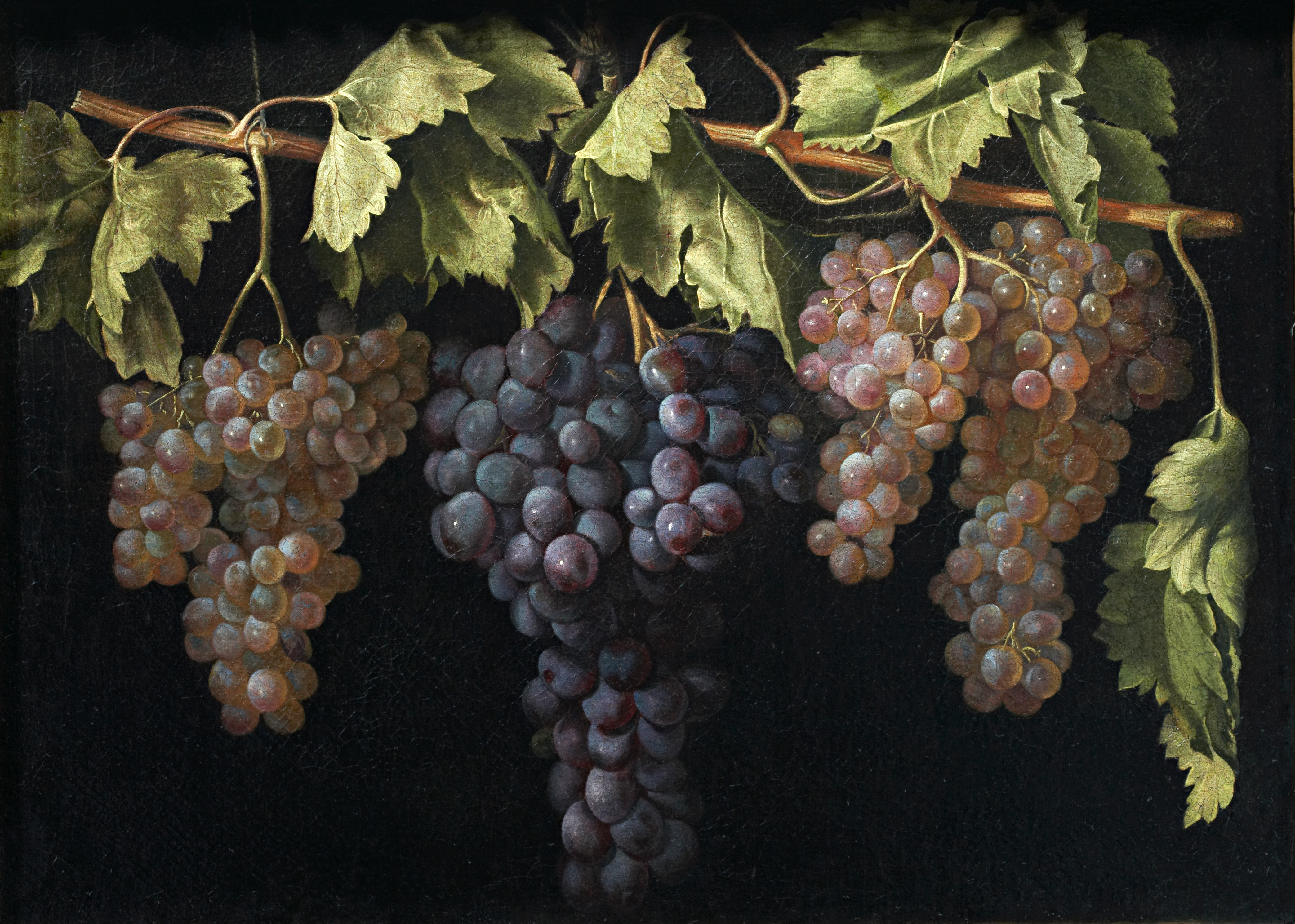
At the entrance to the exhibition, we review the legendary tale about the rivalry between 5th century BC artists Zeuxis and Parrhasius as told by the ancient Roman naturalist and philosopher Pliny the Elder in his Natural History (published in 77 AD).  The story claims that Zeuxis and Parrhasius challenged each other to a painting duel, each trying to out fox the other with their skills of verisimilitude. Zeuxis unveiled his painting of grapes that were so faithfully rendered, birds flew down to peck at these counterfeits.  Parrhasius then showed Zeuxis his handiwork, whereupon this renowned artist, born on the southern tip of today's Italy which was then part of Magna Grecia, attempted to pull back the "curtain" he believed covered his rival's work.  He was mistaken.  Thus, Zeuxis fooled the birds with his meticulous copy of nature, his trompe l'oeil (deceiving the eye), but Parrhasius fooled the artist Zeuxis by making him believe the depicted curtain was a real one. 


 Installation photograph by Beth S. Gersh-Nesic


What does this anecdote tell us?  Early on in art history, the ability for an artist to copy nature faithfully, if not flawlessly, measured an artist's mettle for his contemporary audiences and his peers. It was the true proving-ground for an artist's self-worth.  After this introductory text, we view and learn about the history of trompe l'oeil in fine and applied art, and its connection to still life, through various examples juxtaposed to Cubist works throughout the entire exhibition. 

It's a fascinating story told briefly in the exhibition galleries and at length in Elizabeth Cowling's excellent essay in the catalogue (please buy the catalogue!).  The exhibition "fleshes" out the written narrative. Trompe l'oeil had it heyday in the 17th and 18th centuries and then suffered from a decline in its critical reception toward the end of the 18th century (evident in Diderot's review of the Salon of 1763).  It went downhill from there, well into the twentieth century, when it was associated with craft (housepainter's faux marble and wood) rather than art, an "intellectual" activity. The industrialization of trompe l'oeil on wallpaper seemed to seal the deal on that score. However, Picasso and Braque saw its value differently. Braque's decorative arts background and fine art painter's mind brought a new perception to trompe l'oeil techniques and execution, which in turn ignited Picasso's curiosity.  


Installation view of Cubism and the Trompe l'Oeil Tradition, on view October 20, 2022-January 2023, at the Metropolitan Museum of Art, Photo by Paul Lachenauer, courtesy of The Met


Juan Fernández, "El Labrador", Spanish, documented 1629–1657 
Still Life with Four Bunches of Grapes, ca. 1636 
Oil on canvas 17 11⁄16 × 24 in. (45 × 61 cm) 
Museo Nacional del Prado, Madrid (P7904)


J. S. Bernard, probably French, active 1650s–1660s 
Still Life with Violin, Ewer, and Bouquet of Flowers, 1657 
Oil on canvas 32 x 39 1/2 in. (81.3 x 100.3 cm) 
Fine Arts Museums of San Francisco, Gift of the Christian Humann Foundation (2008.55) 


Cornelius Norbertus Gijsbrechts, Flemish, 1625/29–after 1677 
The Attributes of the Painter, 1665 
Oil on canvas 51 3/16 × 41 13/16 in. (130 × 106.2 cm) 
Musée des Beaux-Arts de Valenciennes (P.46.1.111)


Edward Collier, Dutch, Breda ca. 1640?–after 1707 London or Leiden
 A Trompe l’Oeil of Newspapers, Letters, and Writing Implements on a Wooden Board, 1699 
Oil on canvas 23 1⁄8 × 18 3⁄16 in. (58.8 × 46.2 cm) 
Tate. Purchased 1984 (T03853)


Wilhelm Robart, Dutch, active 18th century, Trompe l’Oeil 1770s
 Ink, ink wash, watercolor, and chalk on paper 15 3/8 × 14 3/16 in. (39.1 × 36 cm) 
RISD Museum, Providence, Gift of Mr. and Mrs. Barnet Fain (2001.93.2)


Louis Léopold Boilly, French, La Bassée 1761–1845 Paris 
Trompe l’Oeil ca. 1799-1804 
Oil on marble with wood trim Diameter: 22 3/4 in. (58 cm) 
Private collection, Canada


John Haberle, 1856–1933 Imitation 1887 Oil on canvas 10 × 14 in. (25.4 × 35.6 cm) 
National Gallery of Art, Washington, D.C. (1998.96.1


William Michael Harnett, 1848–1892, Still Life—Violin and Music 1888
 Oil on canvas 40 x 30 in. (101.6 x 76.2 cm) 
Catharine Lorillard Wolfe Collection, Wolfe Fund, 1963


The exhibition's history of Picasso, Braque and Gris' paintings and collages features their visual conversations with popular trompe l'oeil trends and subject matter, as well as among themselves. Thankfully installed in informative relation to each other, we readily see how well they spoke to each other through their inventive depictions and compositions. Together, they referenced and subverted conventional academic art practice and trompe l'oeil cliché as if commenting on the imposition of ubiquitous industrial decoration and trends in vogue during this new modern age.  (I consider Cubism the original Pop Art.)  

One particularly exciting gallery pairs Picasso's first collage Still Life with Chair Caning (1912), which incorporates a glued piece of manufactured oil cloth bearing a faux chair-caning print onto an oval canvas framed by a real rope, with his 1912 faux collage The Scallop Shell: Notre Avenir Est Dans L'Air.  Still Life with Chair Caning belongs to the Musée Picasso in Paris, and The Scallop Shell belongs to the Met. What a treat to see these two contemporary works from different museums side by side! And, to add more sparkle to this exciting happenstance, we find their predecessor, Georges Braque's early Cubist painting Violin and Palette (1909), which belongs to the Solomon R. Guggenheim Museum, right across the room from Picassos' landmark oval canvases. 

In Violin and Palette, Braque seems to enlist trompe l'oeil for the nail inside the palette's hole and its shadow falling on the palette form.  Art historians explain that the "realistic" nail and shadow at the top of the composition references the Cubists' departure from one-point perspective in the rest of the composition, drawing attention to the interplay between the two realities depicted in art. We can also glean a reference to the direction of the light falling on the objects arranged in this still life (a necessary ingredient for the artist bent on fooling the eye into imagining three dimensions on a two-dimensional surface).


 Pablo Picasso, Spanish, Malaga 1881–1973 Mougins, France 
Still Life with Chair Caning 1912 Oil and printed oilcloth on canvas edged with rope
 11 7/16 × 14 9/16 in. (29 × 37 cm) 
Musée National Picasso-Paris, Dation Pablo Picasso, 1979 (MP 36)


Installation photograph by Beth S. Gersh-Nesic


Installation view of Cubism and the Trompe l’Oeil Tradition, on view October 20, 2022January 22, 2023 at The Metropolitan Museum of Art. Photo by Paul Lachenauer, courtesy of The Met


Georges Braque, French, Argenteuil 1882–1963 Paris 
Violin and Palette, 1909 
Oil on canvas 36 1/8 × 16 7/8 in. (91.8 × 42.9 cm) 
Solomon R. Guggenheim Museum, New York (54.1412)


We also have Braque's first experiments with pasting faux wood wallpaper and painting faux wood on one canvas, hung next to each other on one wall: Fruit Dish and Glass, 1912 (Metropolitan Museum of Art) and Glass, Bottle, and Newspaper, 1912 (Metropolitan Museum of Art). These two works are accompanied by one earlier painting that includes stencil lettering (Homage à J.S. Bach, 1911-12)  and a later painting that emulates faux wood wallpaper  (The Guitar: “Statue d’Épouvante,” 1913).  As a whole, this gallery supports the saga of Braque's discovery of faux wood wallpaper during the summer of 1912, when he and Picasso vacationed in Sorgues.  After Picasso left Sorgues, Braque bought the faux wood wallpaper and began his first series of papier collés (glued papers), the first of this kind of collage in Cubism. That Braque chose to wait until Picasso was no longer around indicates their collaborations and mutual support did not suppress their ardent desire to outdo each other whenever the opportunity presented itself - Juan Gris included.


Installation photograph by Beth S. Gersh-Nesic


Installation photograph by Beth S. Gersh-Nesic


Georges Braque, French, Argenteuil 1882–1963 Paris 
The Guitar: “Statue d’Épouvante,” 1913 
Cut-and-pasted laid, wove, and printed papers, printed wallpapers, charcoal, and gouache on canvas 28 3/4 × 39 3/8 in. (73 × 100 cm) 
Musée National Picasso-Paris, Dation Jacqueline Picasso, 1990 (MP 1990-381) 


And what about Juan Gris? If nothing else, the sheer number and selection of Gris works could have been an exhibition on its own: an "Homage to Juan Gris." For here, alongside the better-known artists Picasso and Braque, the various iterations of Gris' collages and faux collages sing out with strength and fervor, not only due to their size but also their resplendent colors. I would suggest going through the exhibition a few times in order to savor Gris' exciting inventiveness and sensual applications of paint performed within a rigorous geometric composition.   


Three Juan Gris Works
Installation photograph by Beth S. Gersh-Nesic


Juan Gris, Spanish, Madrid 1887–1927 Boulogne-sur-Seine 
Violin and Engraving, 1913 
Oil, sand, collage on canvas 25 5/8 × 19 5/8 in. (65.1 × 49.8 cm) 
Leonard A. Lauder Cubist Collection, Purchase, Leonard A. Lauder Gift, 2022 


Juan Gris, Spanish, Madrid 1887–1927 Boulogne-sur-Seine 
Still Life with a Guitar, 1913 
Oil on canvas 26 × 39 1/2 in. (66 × 100.3 cm) 
Jacques and Natasha Gelman Collection, 1998


Juan Gris, Spanish, Madrid 1887–1927 Boulogne-sur-Seine 
Breakfast, 1914 
Cut-and-pasted printed wallpaper, newspaper, transparentized paper, white laid paper, gouache, oil,
 and wax crayon on canvas 
31 7/8 × 23 1/2 in. (80.9 × 59.7 cm) 
The Museum of Modern Art, Acquired through the Lillie P. Bliss Bequest (248.1948) 


I also appreciated the organization of themes, such as this wall that demonstrates the relevance of Picasso's and Braque's frequent depiction of violins, a favorite subject among trompe l'oeil and still life painters. The curators also organized galleries that highlighted a single series by each artist, providing an opportunity to study in person several works of art that belong to different collections all over the world.  Below are a few examples:

Violins in art
Installation view of Cubism and the Trompe l’Oeil Tradition, on view October 20, 2022January 22, 2023 at The Metropolitan Museum of Art. Photo by Paul Lachenauer, courtesy of The Met


Picasso collages
Installation view of Cubism and the Trompe l’Oeil Tradition, on view October 20, 2022January 22, 2023 at The Metropolitan Museum of Art. Photo by Paul Lachenauer, courtesy of The Met


Juan Gris and Picasso among Old Master still life paintings
Installation view of Cubism and the Trompe l’Oeil Tradition, on view October 20, 2022January 22, 2023 at The Metropolitan Museum of Art. Photo by Paul Lachenauer, courtesy of The Met


Picasso's guitars
Installation view of Cubism and the Trompe l’Oeil Tradition, on view October 20, 2022January 22, 2023 at The Metropolitan Museum of Art. Photo by Paul Lachenauer, courtesy of The Met


Installation view of Cubism and the Trompe l’Oeil Tradition, on view October 20, 2022January 22, 2023 at The Metropolitan Museum of Art. Photo by Paul Lachenauer, courtesy of The Met


Installation view of Cubism and the Trompe l’Oeil Tradition, on view October 20, 2022January 22, 2023 at The Metropolitan Museum of Art. Photo by Paul Lachenauer, courtesy of The Met


Installation view of Cubism and the Trompe l’Oeil Tradition, on view October 20, 2022January 22, 2023 at The Metropolitan Museum of Art. Photo by Paul Lachenauer, courtesy of The Met


Installation view of Cubism and the Trompe l’Oeil Tradition, on view October 20, 2022January 22, 2023 at The Metropolitan Museum of Art. Photo by Paul Lachenauer, courtesy of The Met


Also, while you are walking around the galleries, please pay attention to the exhibition designers' trompe l'oeil painted around the text panels. Such fun! Their humor caught me by surprise as I turned to re-read a text.  And don't forget to look at the final text panel before you exit. I noticed that some people walk directly through the final door without looking back. Just in front of the exit you find Picasso's famous quote "art is a lie that makes us realize truth" accompanied by a playful trompe l'oeil flourish to send you out into the Met's magnificent hall of sculptures.  


Installation photograph by Beth S. Gersh-Nesic


I have only one caveat, not a criticism. The history of Cubism exhibitions continues to inform and surprise. Professors Braun and Cowling heroically researched and developed a valuable method of analyzing Cubist paintings and collages.  Their work benefits from all their previous publications and so many others who contributed to the realization of this show and other exhibitions on Cubism. Each contribution in turn has opened our eyes to new ways of understanding this radical movement, its artistic innovations and its commentaries on contemporary life. Therefore, we must bear in mind that there are many ways to analyze a Cubist work. Here, in this wonderful show, we acquire yet another one, but not the only one.

Please buy the exhibition catalogue Cubism and the Trompe l'Oeil Tradition (published by the Metropolitan Museum of Art and distributed by Yale University Press). It includes excellent essays by the curators, art historian Claire Le Thomas, and Rachel Mustalish, conservator at the Met, as well as a valuable bibliography of sources that broaden our vision when it comes to the study of Cubism, its art and its artists. Fortunately, the images and evidence in this generous book will remain after the exhibition becomes a distant memory. 


Pablo Picasso, Spanish, Malaga 1881–1973 Mougins, France 
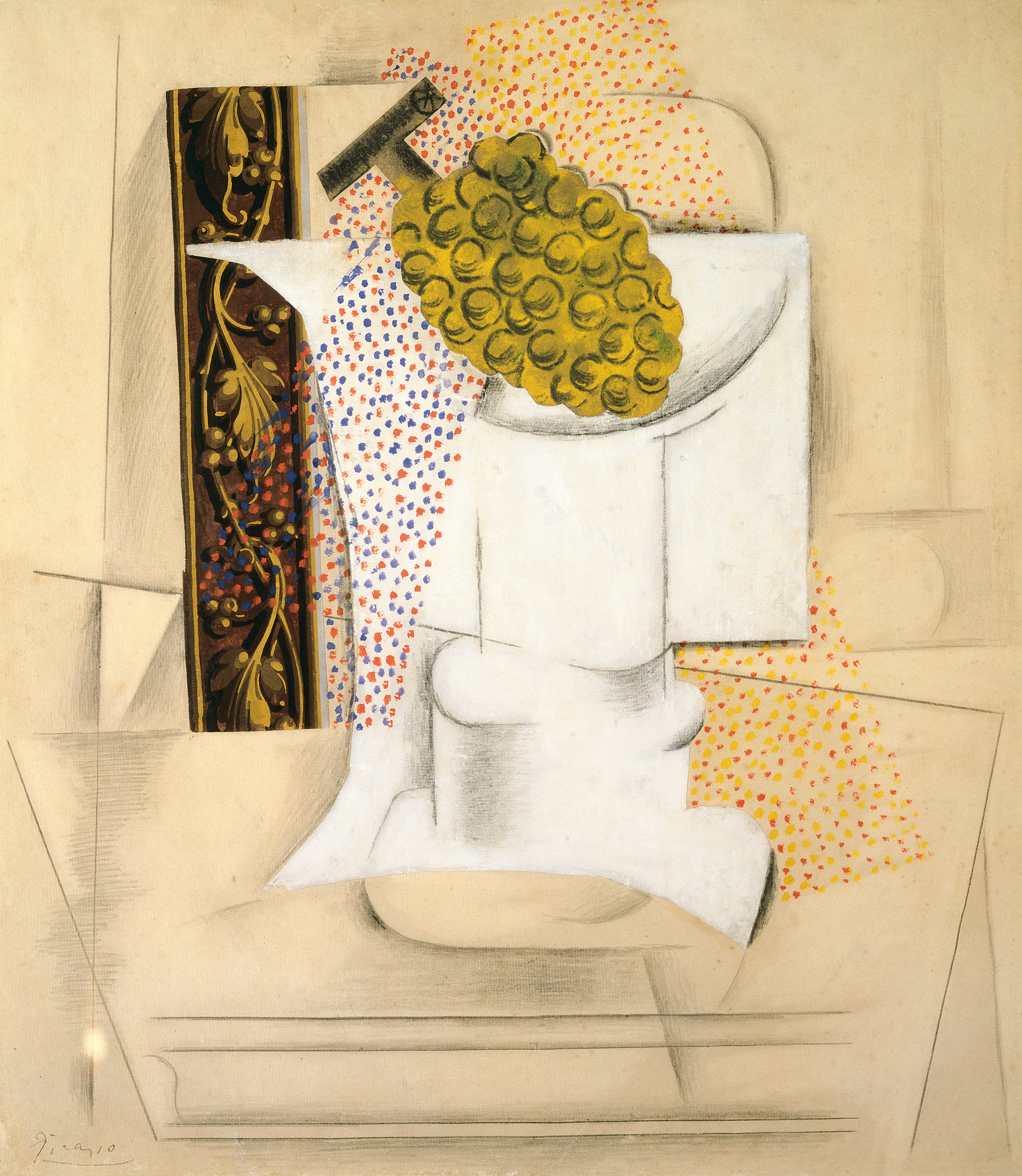
Fruit-Dish with Grapes, 1914 
Cut-and-pasted printed wallpaper, laid and wove papers, gouache, and graphite on laid paper
 18 7/8 × 16 3/4 in. (47.9 × 42.5 cm) Private collection


Pablo Picasso, Spanish, Malaga 1881–1973 Mougins, France 
Dice, Packet of Cigarettes, and Visiting-Card, 1914 
Cut-and-pasted laid and wove papers, charcoal, graphite, printed commercial label, and printed calling card on laid paper 
5 1/2 × 8 1/4 in. (14 × 21 cm) 
Yale University Art Gallery, New Haven, Transfer from the Beinecke Rare Book and Manuscript Library, Gertrude Stein and Alice B. Toklas Collection, Yale Collection of American Literature (1980.130)


Needless to day, as we walk through the galleries, we must not lose sight of the sheer beauty the Old Master still life paintings and Cubist works bring to this landmark occasion. Yes, the first visit to this show may narrow your view, drawing you into the remarkable technical prowess of trompe l'oeil and the Cubists' fun playing with their specialized tools.  A second visit might yield another meditation, perhaps on the shared subject matter or the distinct personalities each artist brought to their shared enterprise.  And the third, well - the third should focus on the joy of looking, savoring and memorizing what these real objects accomplish that reproductions never can. Therein lies a precious "truth" which Picasso's refers to in the statement printed on the final wall of the show. 

During this challenging period of navigating so-called facts and evident fabrications, an exhibition that studies the artists' preoccupation with truth in fakery comes at a timely moment for us all. 


Pablo Picasso, Spanish, Malaga 1881–1973 Mougins, France 
Still life with Compote and Glass, 1914-1915 Oil on canvas 25 × 31 in. (63.5 × 78.7 cm) 
Columbus Museum of Art, Gift of Ferdinand Howald (1931.087)


Pablo Picasso, Spanish, Malaga 1881–1973 Mougins, France 
Glass, Newspaper, and Die, 1914 
Oil, painted tin, iron wire, and wood 6 7/8 × 5 5/16 × 1 3/16 in. (17.4 × 13.5 × 3 cm) 
Musée National Picasso-Paris, Dation Pablo Picasso, 1979 (MP 45)


Wishing you a pleasant weekend and New Moon in Aquarius,
Beth

Beth S. Gersh-Nesic, PhD
Director/owner
New York Arts Exchange, LLC
Editor and manager of the official André Salmon website and blog