From Ukraine to Paris: Sonia Delauney
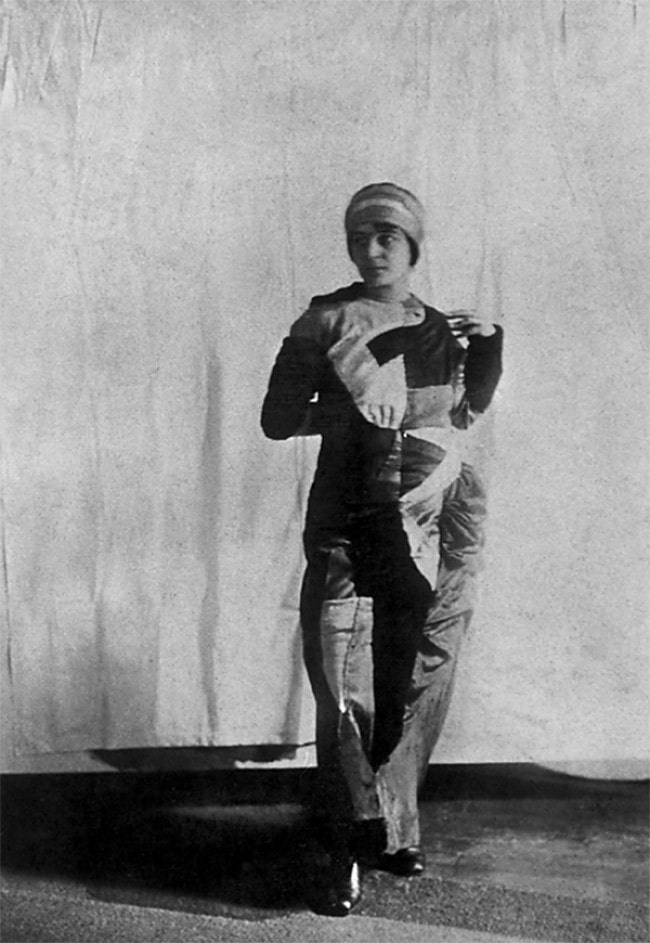
Sonia Delaunay in a Simultaneous Dress, 1913 , Public Domain
Above all, Sonia Delaunay enriched the Cubist subgroup Orphism. Together with her husband Robert Delaunay and Czech artist František Kupka, they invented a fusion of Cubist geometricity and Pointillist color theory inspired by French chemist Michel Eugène Chevreul (1786-1889). Then fueled by Gauguin, Van Gogh and the Fauves’ palettes, their “simultaneous contrasts” in color, light, and form married recognizable figuration to abstraction in an effort to invent a dynamic “pure painting.” The concept behind their shared endeavor created a new language for art, a “non-literary” form, they would say. Theirs was a utopian vision of unwavering certainty that color emitted an energy that expressed modernity.
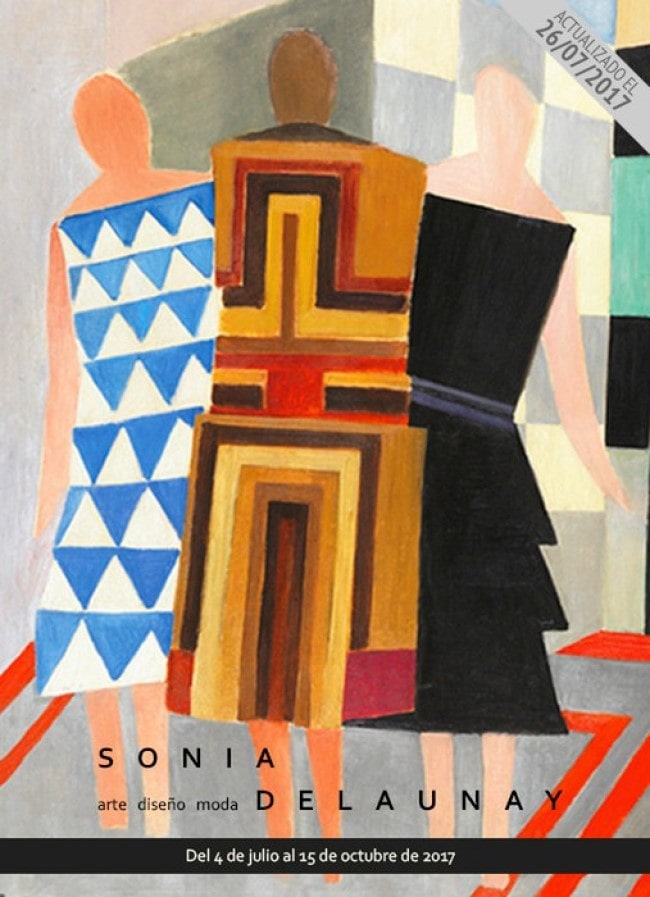
Catalogue, Museo Nacional Thyssen- Bornamisza, July 4-October 14, 2017
Where did this all begin? In poverty. Allegedly born on November 14, 1885 in a small town near Odessa to a Jewish factory worker Elias Stern and his wife Hannah, Sonia Delaunay came into the world as Sarah Élievna (Eliyivna). Five years later, her mother’s childless brother and sister-in-law, Henri and Anna Terk, took Sarah into their home in St. Petersburg. Some sources claim they adopted her, but there is no proof this occurred. Nevertheless, Sarah became Sofia, and then Sonia Terk. Her uncle was a wealthy lawyer, who could provide a comfortable and cultured lifestyle that her birth parents could never afford. Anna introduced Sonia to literature and music. She made sure Sonia learned different languages by hiring native-speaking governesses. By 14 years old, Sonia mastered Russian, German, French, and English. Eventually, she added Spanish to this list. Also, the Terks traveled extensively throughout France, Italy, and Germany. They owned a summer home in Finland (part of the Russian Empire from 1809 to 1917).
While pursuing her studies at a women’s high school in St. Petersburg, the teachers encouraged Sonia’s drawing skills. In 1903 she studied art at the Academy of Fine Arts in Karlsruhe, Germany. Two years later she set off for Paris, enrolling in the Académie de la Palette under the direction of Jacques-Émile Blanche. (In 1912, the Salon Cubists Henri Le Fauconnier, Albert Gleizes and Jean Metzinger took over the school and developed a “Cubism” curriculum.) The rigid instruction at the Académie de la Palette ceased to please her and she dropped out. Nevertheless, she met numerous budding artists and dealers through her enclave of young Russian art students, among them the German art critic and dealer Wilhelm Uhde, who mounted her first solo show in 1908 at his new Galerie de Notre-Dame des Champs. Her work reflected her admiration for the Fauves (the “Wild Beasts”), the most radical movement on the scene since she arrived in Paris.
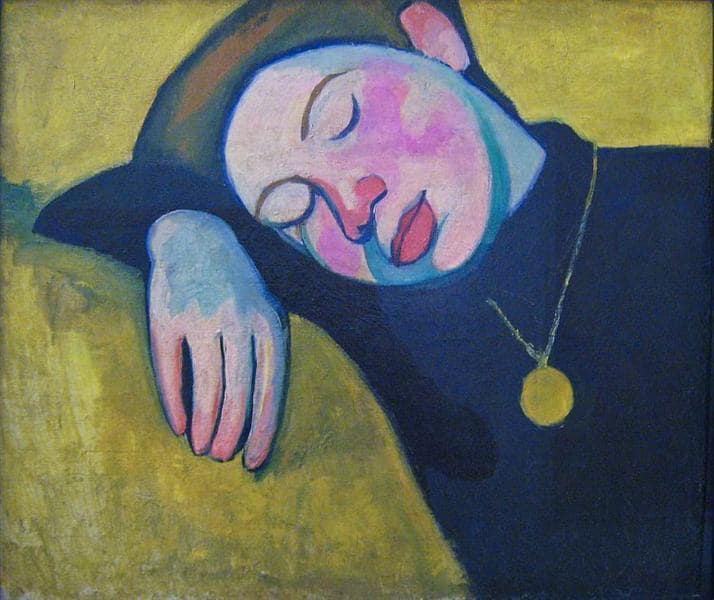
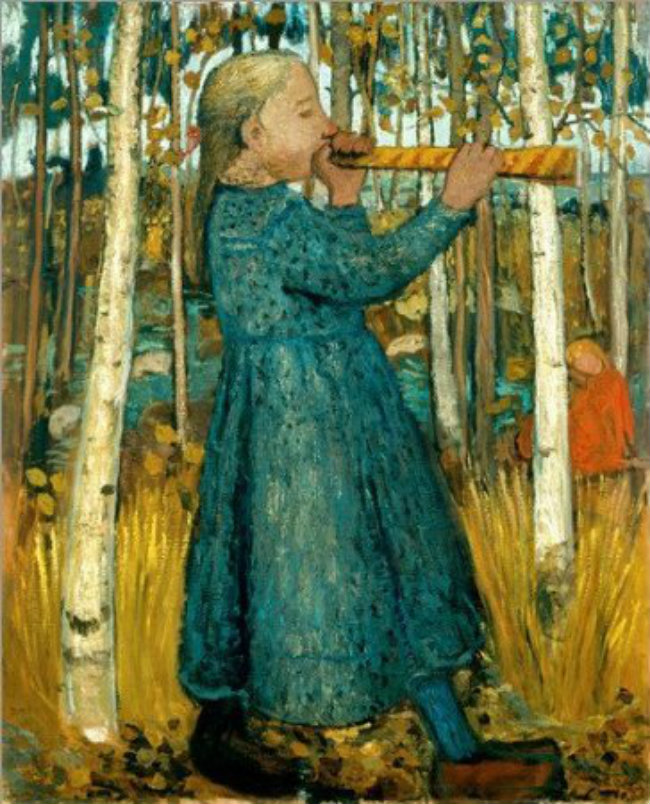
Sonia Delaunay, Sleeping Girl, 1907, Source: Wikipedia
We know that Sonia studied engraving with the German artist Rudolf Grossmann, introduced to her by the Bulgarian Jules Pascin, who also exhibited at Uhde’s gallery. She also knew the German Hans Purmann, who studied at the Académie Matisse. On December 5, 1908, she married Uhde while on holiday in London. It was a mariage blanc, since Uhde preferred men. Based on friendship and intellectual compatibility, their legal union allowed Sonia to stay in Paris, rather than return to her parents and their conventional bourgeois expectations.
Within the Uhde’s circle was the young well-to-do French artist Robert Delaunay, whose aunt and uncle raised him while his mother lived on her own. At first, Sonia accompanied Robert to galleries and museums. Finally, they fell in love and married in November 1910, several months after an amicable divorce from Uhde. Uhde and Sonia remained close friends until Uhde’s death in 1947. On January 18, 1911, Sonia and Robert Delauney welcomed a son Charles, who became a well-known jazz promoter through his own magazine, Le Jazz Hot, and the jazz organization Le Hot Club de France begun in 1931.
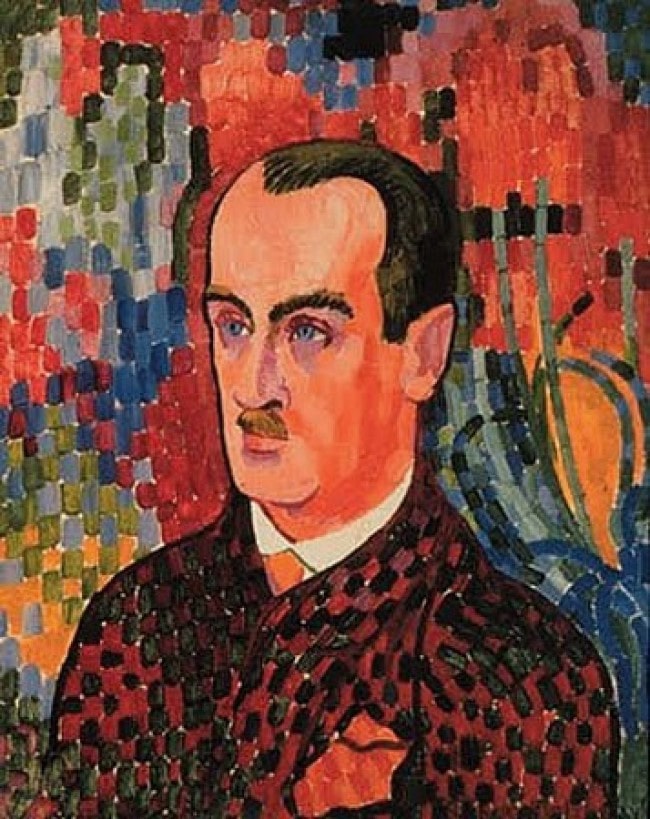
Robert Delaunay, Portrait of Wilhelm Uhde, 1907, Public Domain, Source: Wikipedia
Like most mothers, Sonia drew upon family traditions as she tended to her newborn. For a blanket, she sewed together various sized scrapes of different colored fabrics, inspired by examples she had seen in rural Ukraine settings. This uneven checker-board patchwork quilt now belongs to the Cubist collection at the Centre Pompidou in Paris. In a 1967 interview, Sonia described the impact of this creation on her own artistic direction: “When [the blanket] was finished the arrangement of the pieces of material seemed to me to evoke Cubist conceptions and we tried then to apply the same process to other objects and paintings.”
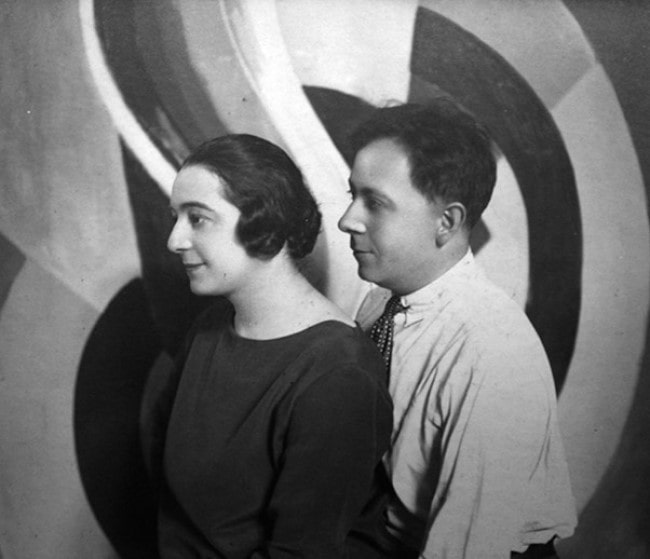
Sonia and Robert Delaunay, 1923, Source: Women Essentia website
The Delaunays knew about Wassily Kandinsky’s color theories through Sonia’s translation of the Russian artist’s book Concerning the Spiritual in Art (1911). Kandinsky studied art at the Grekov Odessa Art School in Ukraine. He exhibited his first nonobjective painting in December 1911, after Sonia created her son’s patchwork quilt blanket.
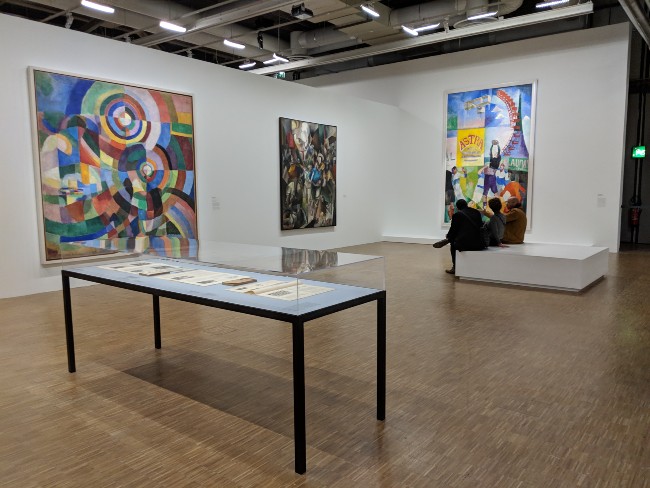
Cubisme S’Expose, Centre Georges Pompidou, October 17, 2018-February 25, 2019. Photo of installation by Beth S. Gersh-Nesic. From left to right: Sonia Delaunay, Electric Prisms, 1914. Albert Gleizes, Soccer Players, 1912-13. Robert Delaunay, Cardiff Team, 1912-13
Art historians believe this handmade object led to Orphism or Orphic Cubism, a movement christened by their very close friend poet-art critic Guillaume Apollinaire, who categorized the apparently different Cubist styles in his 1913 book Aesthetic Meditations: The Cubist Painters. That same year, Apollinaire introduced Sonia and Robert to the poet Blaise Cendrars, which led to one of the best-known Cubist collaborations, the “simultaneous” poem La Prose of the Trans-Siberian and of Little Jehanne of France, a two-meter length text, hand painted in watercolors along the left border. The total work was printed with pochoir on paper glued together into an accordion-style book and published by Cendrars himself through his own small press called Éditions des Hommes Nouveaux (New Men Publishers). The original venture envisioned a run of copies that would measure, from its first to last page, the height of the Eiffel Tower, Robert Delaunay’s favorite symbol for modernity. However, they never reached this goal.
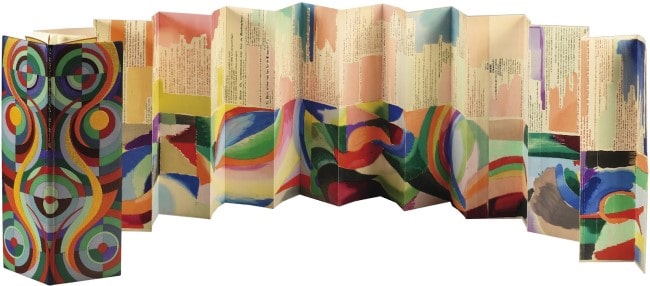
Sonia Delaunay and Blaise Cendrars, La Prose du Transsibérien et de la Petit Jehanne de France 1913, Museum of Modern Art. Source: Wikipedia
Most importantly, Sonia’s brilliant visual interpretation of Cendrar’s poem electrified their avant-garde circles, garnering recognition from her French colleagues, the Italian Futurists, and Der Blaue Reiter. The colorful visual rhythms seem to flow with the poet’s language and the gyrations of train travel, capturing a flurry of random thoughts enhanced by different shaped and sized letters (what we call fonts today). “Painting is a form of poetry,” she said, “colors are words, their relations rhythms, the completed painting a completed poem.”
Delaunay and Cendrars exhibited the book in September 1913, in the first Autumn Salon in Berlin. Apollinaire reviewed the show and listed Sonia’s other contributions: a poster, other book bindings, a lamp and lampshade, curtains, cushions, and goblets, all decorated in her signature “simultaneous” geometric vocabulary. In 1914, she exhibited her most famous painting Electric Prisms in the spring Salon des Indépendants. At the same time, she also created wigs made of different color wools.
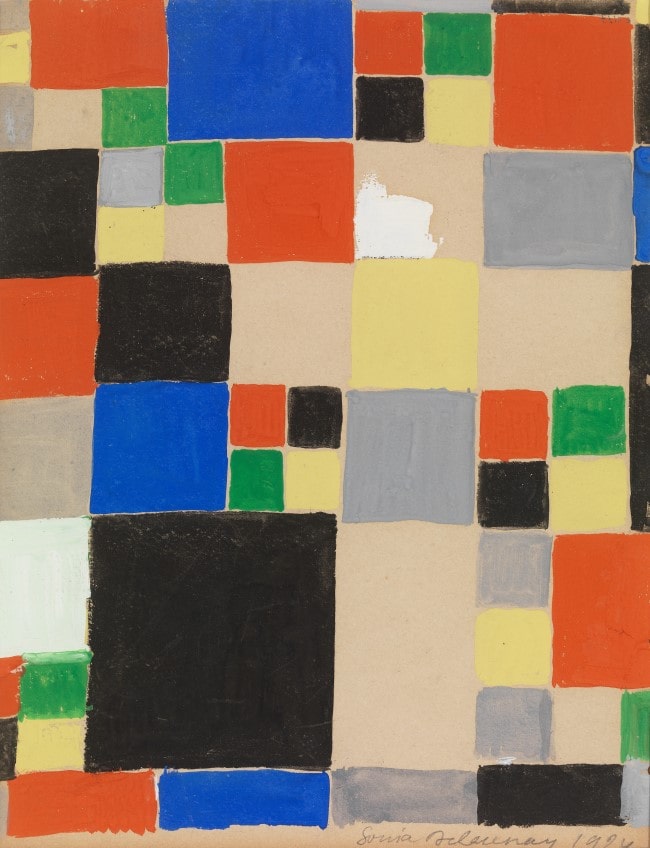
Sonia Delaunay, Fabric Project, 1924. Draft decoration on fabric, gouache on paper, 23.5 x 31 cm. Louisiana Museum of Modern Art, Humlebaek. Donation: The Joseph and Celia Ascher Collection, New York. Photo: Paul Buchard/Brøndum & Co., ©PRACUSA S.A.
That year, while on vacation in Spain, World War I broke out. The Delaunays decided to remain there for a while. Then they moved to Portugal in 1915. Meanwhile the Russian Revolution in 1917 ended the Delaunays income from Sonia’s inherited properties. Robert’s artwork rarely sold. Characteristically industrious and confident, Sonia took on the responsibility of providing an income for her family. In 1918, they moved to Madrid, where Sonia opened Casa Sonia, a small boutique that featured her “simultaneous” apparel and decorative objects. She also met several personalities in the arts, including the Russian impresario Sergei Diaghilev who directed the Ballets Russes. He commissioned costumes and sets from Sonia and Robert Delaunay for his production of Cléopâtre because the original costumes and sets designed by the Russian artist Leon Bakst in 1909 were destroyed in a fire. That same year, 1918, Sonia designed costumes for the opera Aïda, staged at the opulent Gran Teatro del Liceu in Barcelona.
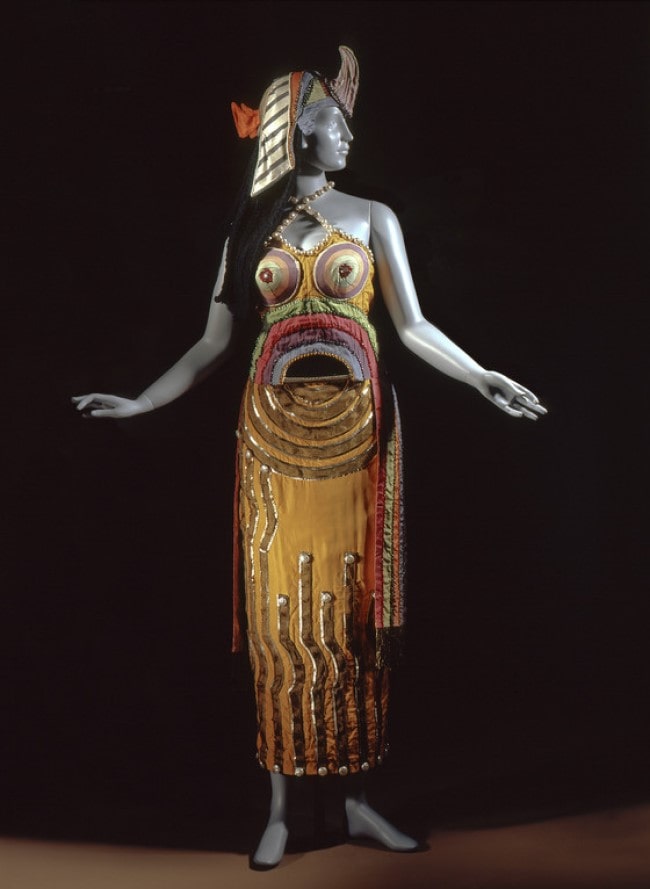
Sonia Delaunay, Costume for Cléopatra, 1918, worn by Lubov Tchernicheva, Source: LACMA public domain
The Delaunays returned to Paris in 1921 to a mixed reception. Because Robert sat out World War I in Spain and Portugal, some friends and colleagues in France did not welcome them back with open arms. Sonia’s attempt to collaborate with the haute couturier Paul Poiret failed because he thought Robert was a deserter. Nevertheless, Sonia Delaunay forged new friendships and partnerships. They entered the Dada-Surrealist circles. Sonia designed costumes for Tristan Tzara’s The Gas-Operated Heart, performed during the Dada Salon at the Galerie Montaigne on June 10th. She also collaborated with the established fashion designer Jacques Heim. Together they sold Delaunay’s distinctive clothing designs to the wealthy elite, such as the British writer and heiress Nancy Cunard and the American movie star Gloria Swanson.
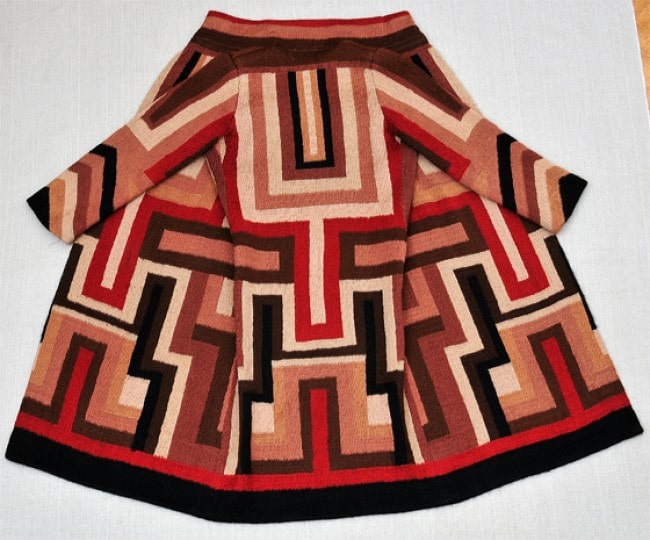
Sonia Delaunay, Coat designed for Gloria Swanson, 1923-24, Source: Wikipedia
Their “boutique simultané” in the 1925 International Exhibition of Modern Decorative Arts and Industry attracted new customers. Two years later Delaunay lectured at the Sorbonne about the influence of her paintings on her clothing designs. Her success as a fine artist and fashion designer knew no limits. She had carved out a niche for commercial success, while her husband’s artwork remained more valuable than hers.
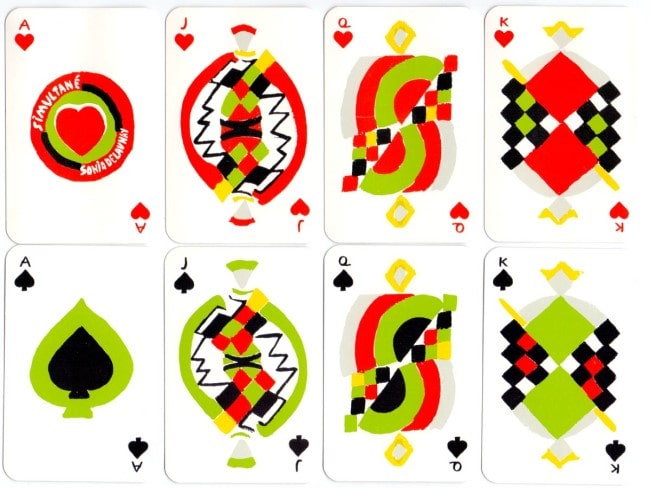
Sonia Delaunay, Simultaneous Playing Cards, 1938, Public Domain
By 1935, Sonia began working on the commissioned murals for the 1937 Universal Exposition in Paris for the Palais de l’Air and the Palais des Chemins de Fer. Her theme was Distant Travel. In 1938, she designed a deck of cards for a German playing card company. Meanwhile, the Delaunays hosted their famous “Thursday Nights” where Robert held forth on his theories about modern art and the “New Reality,” which he promoted in his exhibition the Salon des Réalités Nouvelles, at Galerie Charpentier in 1939.
With the onset of the Occupation, the Delaunays moved south to Montpellier, where Robert died on October 25, 1941. Sensitive to her grief, Swiss Surrealist artists Jean Arp and Sophie Tauber-Arp invited Sonia to live with them in Grasse. She returned to Paris after World War II in 1945. From then on, she tirelessly promoted Robert’s body of work, including his writings. In 1946, she partnered with curator Frédo Sidès to mount another Salon des Réalités Nouvelles.
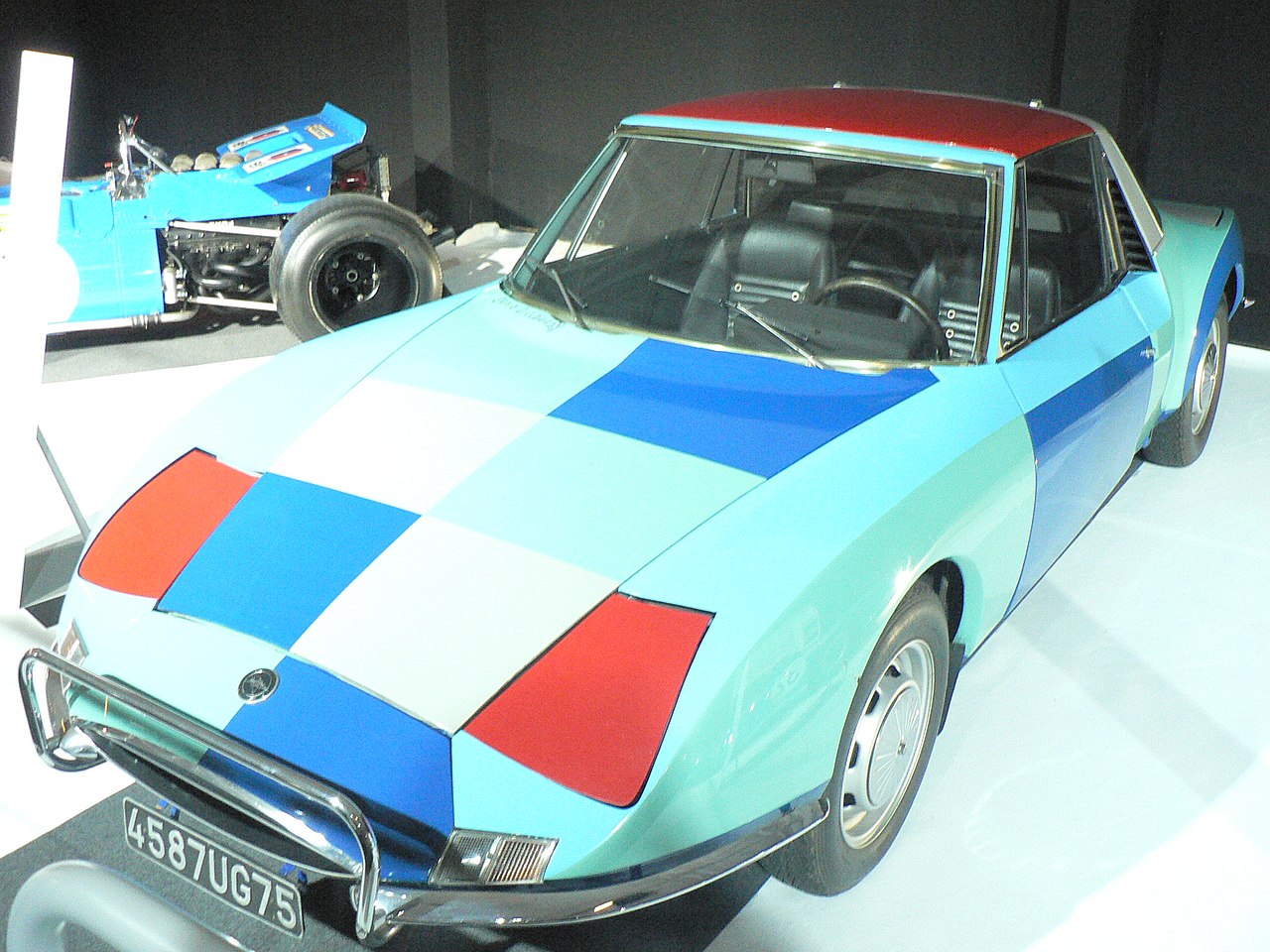
Sonia Delaunay, Matra M530, 1967, hand painted for “Five Cars Personlized by Five Contemporary Artists,” sponsored by the magazine Réalité to fundraise for medical research
While she promoted Robert’s legacy, her own career began to gain traction. In 1953 she had her first solo exhibition since her 1908 show at Wilhelm Uhde’s gallery. This time it took place at Galerie Bing. Two years later Rose Fried Gallery in New York held her first solo exhibition in the United States. Ten years later, in 1965, the National Gallery of Canada in Ottawa organized the first retrospective of Robert and Sonia Delaunay’s body of work in North America. This exhibition traveled to Montreal, Toronto, Winnipeg, Regina, and Quebec.
In 1964, Sonia donated 114 works to the Musée National d’Art Moderne in Paris, where, three years later, her first major retrospective of 197 works took place. Then well into the next century, 47 years later, the Musée d’Art Moderne de Paris organized a more extensive retrospective of 400 objects, which included the last years of her prolific body of work. This exhibition took place from October 17, 2014 to February 22, 2015.
In 1964, she received the Chevalier de la Légion d’Honneur, upgraded in 1975, to Officier. In 1978, she published her memoir with help from her companion, publisher and poet Jacques Damase. On December 5, 1979, she died in Paris. She was buried in Gambais, next to her husband Robert. Three years later, the fashion photographer David Seidner published a personal tribute and interview with the Ukraine-French artist in the magazine Bomb. This lively exchange captures Sonia Delaunay’s sharp wit and humility.
I applaud the curators’ efforts to honor the legacy of Sonia Delaunay by replacing traditional art categories with a more catholic approach to their exhibitions. Sonia Delaunay would have been proud. Both Robert and Sonia Delaunay believed in an art without hierarchies. They also believed that art should speak to everyone, directly through the inherent energy of color. A fan of Ludwig Lejzer Zamenhof’s Esperanto (invented in the late 1870s), Sonia believed that color held the key to creating a universal language in art.
In 1949, she wrote: “[Abstract art] is a mysterious language in tune with the vibrations, the life itself, of color. In this area, there are new and infinite possibilities.” (Stanley Baron and Jacques Damase, Sonia Delaunay, Thames and Hudson, 1995, p. 199.)
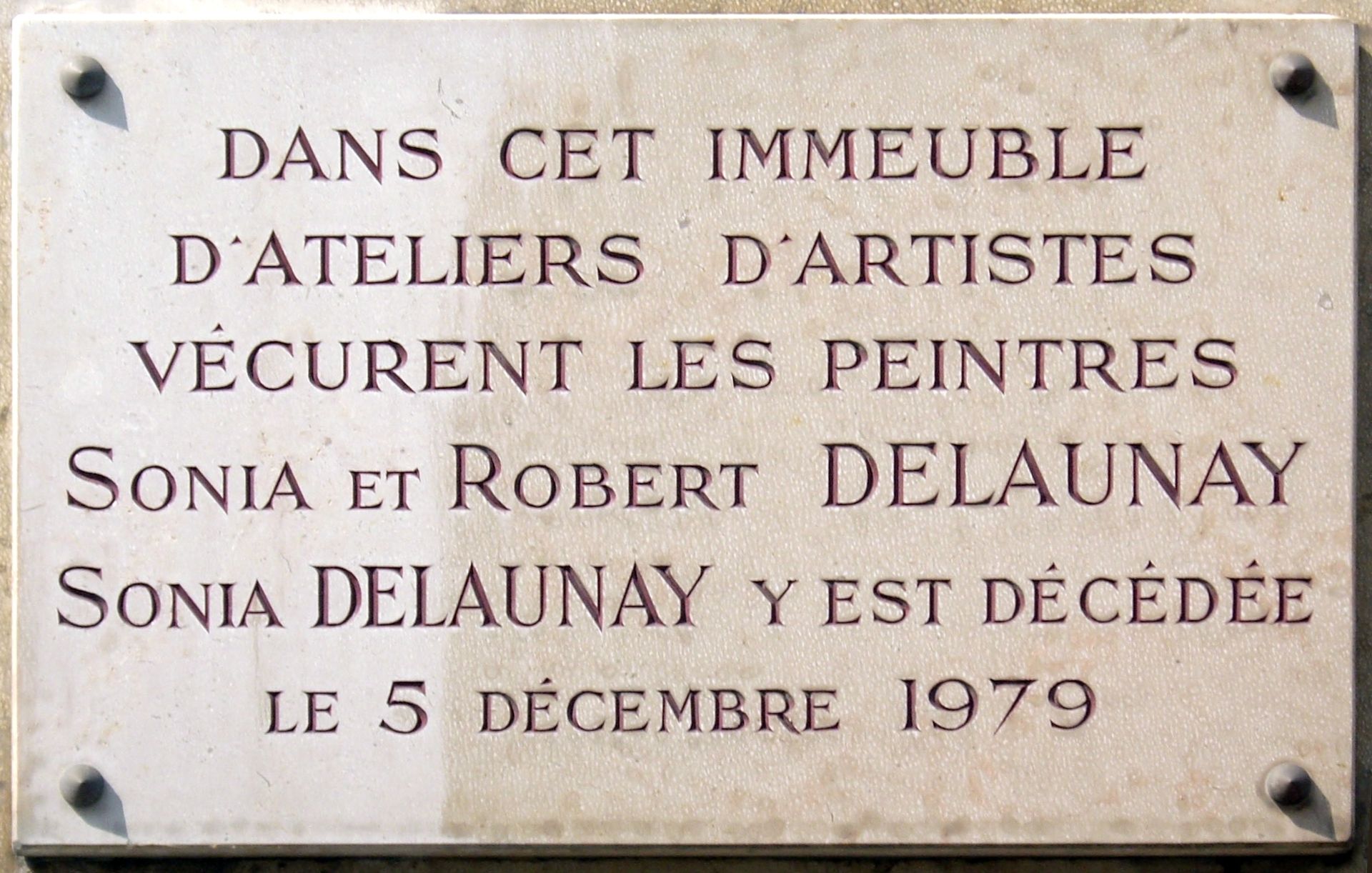
Plaque at 16 rue Saint-Simon, 7th Arrondissement, where Robert and Sonia Delaunay lived from 1935, and Sonia died on December 5, 1979