Showing posts with label Diane Radycki. Show all posts

Sunday, June 23, 2024

Paula Modersohn-Becker, Neue Galerie, through September 2; Diane Radycki lecture June 28


Paula Modersohn-Becker with Elsbeth, c. 1903

Dear Friends,

Three great women artists are on view right now in New York, but the clock is ticking. Please make plans to take advantage of this superb simultaneous presentation of these excellent early 20th century modernists whose lives were as remarkable as their art:

Paula Modersohn-Becker, Neue Galerie, 86th and Fifth Avenue, NYC, through September 9, 2024.   PMB specialist Professor Emerita Diane Radycki on Thursday, June 27th at 6:30 pm.  Tickets.

Sonia Delaunay: Living Art, Bard Graduate Center, 38 West 86th Street, NYC, through July 7, 2024. (only 15 more days).

Käthe Kollwitz, Museum of Modern Art, 11 West 53rd Street, NYC, through Saturday, July 20th for general audiences; Sunday, July 21st for members only.


Paula Modersohn-Becker

Today's blog post is dedicated to Paula Modersohn-Becker. It's an edited version of my 2016 review of the PMB retrospective in Paris, originally published in Bonjour Paris. (Full access by subscription).)
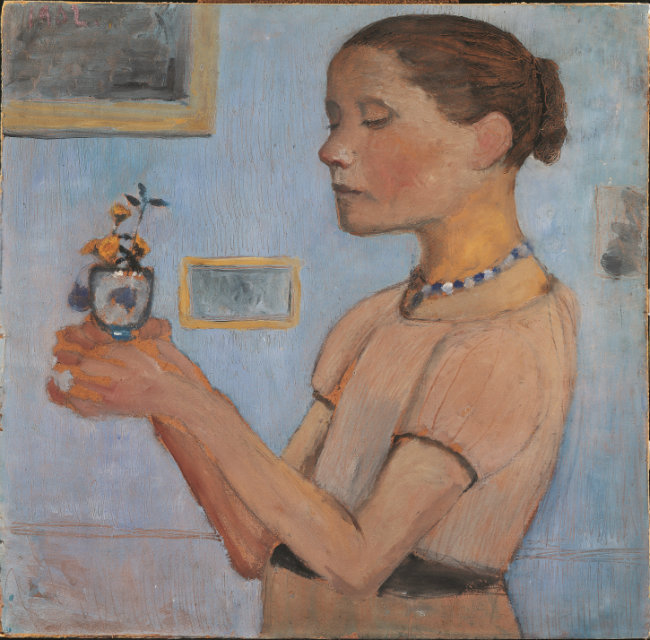
Paula Modersohn-Becker, Girl Holding a Glass with Yellow Flowers, 1902, distemper on cardboard, 52 x 53 cm, Bremen, Kunsthalle Bremen-Der Kunstverein in Bremen, © Paula-Modersohn-Becker-Stiftung, Bremen.

Paula Modersohn-Becker, Girl Holding a Glass with Yellow Flowers, 1902, distemper on cardboard, 52 x 53 cm, Bremen, Kunsthalle Bremen-Der Kunstverein in Bremen, © Paula-Modersohn-Becker-Stiftung, Bremen.


Paula Modersohn-Becker (1876-1907) lived like a modern heroine in a feminist film about self-determination and self-actualization. She studied art in various schools in her native Germany and in Paris. Born on February 8, 1876 in Dresden to the son of a university professor and daughter of a minor aristocrat, she moved with her family to Bremen in 1888 because of her father’s job with the railroad. Her father’s half-sister in London introduced her to art and arranged for lessons there. Upon Paula’s return to Bremen she enrolled in a teacher training program to satisfy her parents’ pragmatism. She also arranged for private art lessons on the side. This lasted from 1893 to 1895. In 1896, she moved to Berlin to study at the Association of Women Artists and in 1897, she moved into an artists’ colony in Worpswede, northeast of Bremen, where she met her future husband, the painter Otto Modersohn.
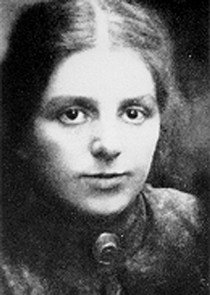


Photo of Paula Modersohn-Becker, 1904.

Photo of Paula Modersohn-Becker, 1904.

On New Year’s Day 1900, Paula and her closest friend in Worpsweder the sculptor Clara Westhoff set out for Paris to study art. Paula attended the Académie Colarossi, which accepted women, and anatomy lessons at the École des Beaux-Arts.  She returned to Worpsweder in June.  The following September, German-Czech poet Maria-Reiner Rilke joined the artists’ colony group. On April 28, 1901 he married Clara Westhoff and on May 25th, Paula married Otto. She also became a stepmother to Elsbeth, Otto’s daughter by his first wife, who died in 1900. The Rilkes had a daughter Ruth on December 12th and moved to Paris without Ruth in 1902. Paula would visit them and study art in 1903 and 1905, but eventually these short sojourns were not enough. On February 23, 1906, Paula left Otto to live permanently in Paris.

Paula Modersohn-Becker, Self-Portrait on Sixth Wedding Anniversary, 1906


Her goal was to become “something” in the art world, to find her own authenticity that might gain recognition among her peers.  She often socialized with Clara and Rainer Maria Rilke in Paris and through them gained access to an exploding experimental art world. Another German couple, Lee and Bernard Hoetger, introduced her to various artists including Henri Rousseau in 1906 (according to Bernard’s recollections). Enchanted by Gauguin’s exotic primitivism, van Gogh’s colorful expressionism, and the Louvre’s masterpieces, from Egyptian Fayum funerary portraits c. 100 BC-300 AD to J.A.D. Ingres’ somewhat mannered Mademoiselle Rivière of 1806, she discovered ample resources to guide her anti-classical approach to contemporary subjects. 


Paula Modersohn-Becker, Reclining Mother and Child, 1906


She tried to make a go of living as an independent artists from 1906 to 1907, but returned to her husband in the spring, pregnant from his visit in Paris earlier that year. She died on November 20th, after giving birth to her daughter Mathilde on November 2nd.
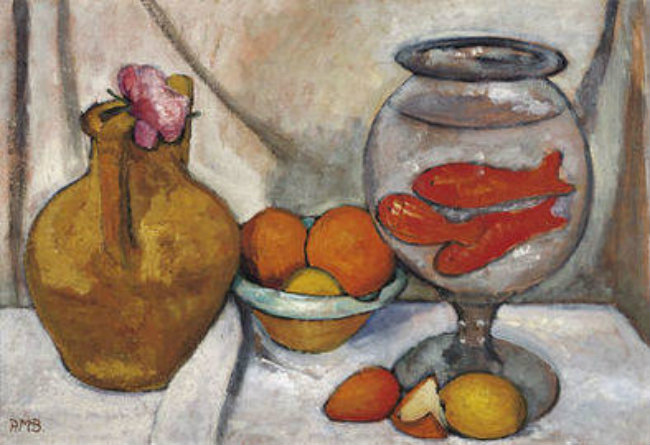
Paula Modersohn-Becker, Still Life with Gold Fish Bowl, May-June 1906, distemper on cardboard, 50.5 x 74 cm, Von der Heydt-Museum, Wuppertal, © Paula-Modersohn-Becker-Stiftung, Bremen.
Paula Modersohn-Becker, Still Life with Gold Fish Bowl, May-June 1906, distemper on cardboard, 50.5 x 74 cm, Von der Heydt-Museum, Wuppertal, © Paula-Modersohn-Becker-Stiftung, Bremen.


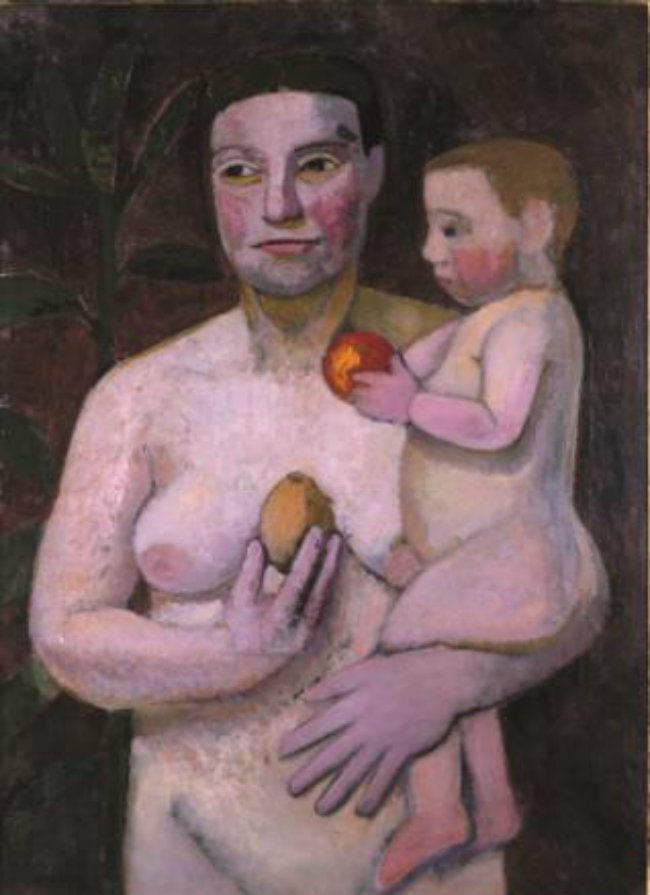
Paula Modersohn-Becker, Nude Mother and Child in Her Arms, Autumn 1906, distemper on canvas, 80 x 59 cm, Museum Ostwall im Dortmunder U, Dortmund, © Museum Ostwall im Dortmunder U, Dortmund .

Paula Modersohn-Becker, Nude Mother and Child in Her Arms, Autumn 1906, distemper on canvas, 80 x 59 cm, Museum Ostwall im Dortmunder U, Dortmund, © Museum Ostwall im Dortmunder U, Dortmund .


In her compelling book Paula Modersohn-Becker: The First Modern Woman Artist (Yale, 2013), art historian Diane Radycki points out the unprecedented modernism of Modersohn-Becker’s women, especially nude mothers who exude an authentic naturalness that male artists had not achieved heretofore.  Modersohn-Becker’s retrospective in Paris gives us an opportunity to examine her uniquely modernist approach to the maternal nude and her modernist preference for a medium that contributed further to an unidealized female figure.  Her choice of distemper paint, a water-based recipe that mixes chalk and pigment with an animal glue or milk-based casein, produces a rough, pasty texture, as if a liquid base were thickened with fine sand. The effect in Modersohn-Becker’s work adds a rustic quality to the image, contrasting quite starkly with the polished refined surface of an academic painting and the contemporary primitivist Henri Rousseau, who strove to achieve a similar linear clarity with his oils. Modersohn-Becker, on the other hand, chose oil far less often and that choice seems quite deliberate.
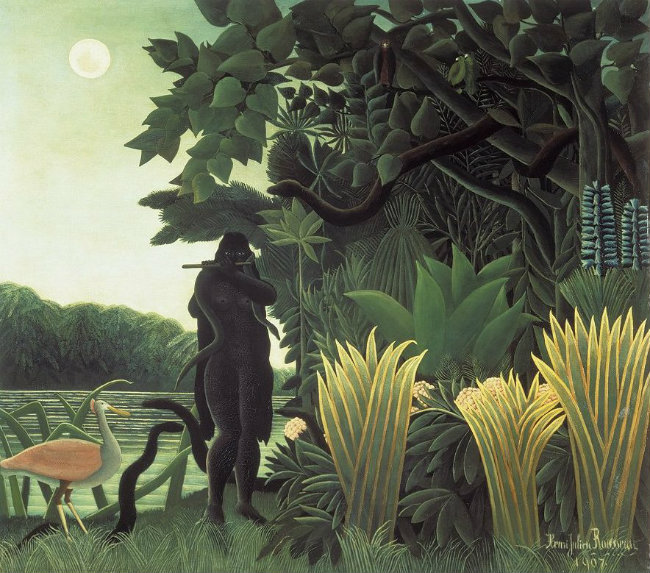


Henri Rousseau, Snake Charmer, 1907, oil on canvas, 167 x 189.5 cm Paris, Musée d’Orsay © RMN-Grand Palais (musée d'Orsay) / Hervé Lewandowski.

Henri Rousseau, Snake Charmer, 1907, oil on canvas, 167 x 189.5 cm Paris, Musée d’Orsay © RMN-Grand Palais (musée d’Orsay) / Hervé Lewandowski.
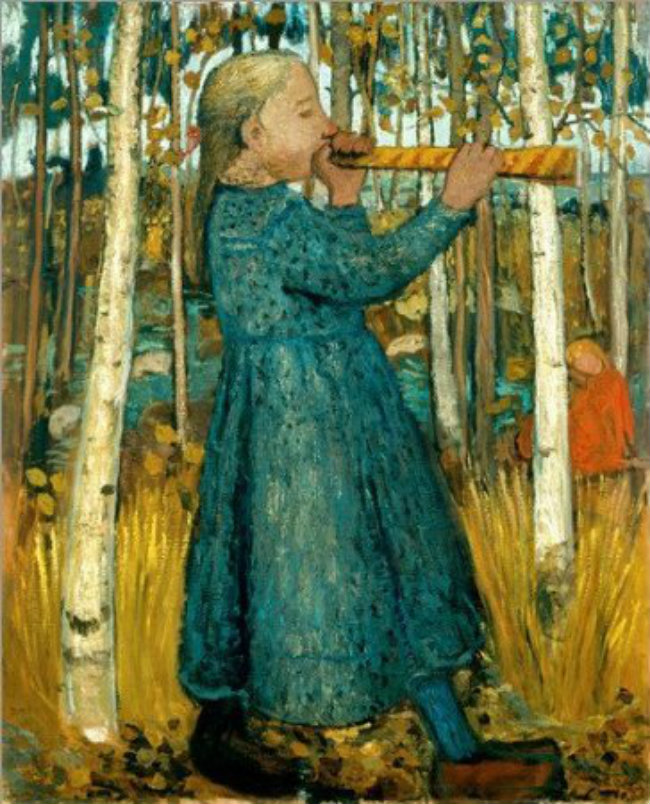
Right: Paula Modersohn-Becker, Girl Playing a Flute in the Forest of Birch Trees, 1905, distress on canvas on wood, 110.4 x 90.2 cm, Museen Böttcherstrasse, Paula Modersohn-Becker Museum, Brême © Paula-Modersohn-Becker-Stiftung, Bremen.

Right: Paula Modersohn-Becker, Girl Playing a Flute in the Forest of Birch Trees, 1905, distress on canvas on wood, 110.4 x 90.2 cm, Museen Böttcherstrasse, Paula Modersohn-Becker Museum, Brême © Paula-Modersohn-Becker-Stiftung, Bremen.

Modersohn-Becker’s decision to live and study art in Paris transformed her native talent into an original approach to modernism. Radycki claims this made her the “first modern woman artist” in art history.  She benefited from a dynamic period of growth among young avant-garde artists, male and female.  Two other important female modernists' retrospectives join hers in New York this summer.  We are fortunate to have this opportunity to compare these three highly accomplished artists and savor their significant contributions to modern art.


Paula Modersohn-Becker Monument by Bernhard Hoetger, 1907

Warm wishes from a very hot NY,

Beth

Beth S. Gersh-Nesic, PhD

Director/owner, New York Arts Exchange, LLC

Staff writer, Bonjour Paris


Saturday, March 5, 2016

Last Call for Paula Modersohn-Becker at Galerie St. Etienne, through March 12: Art Fairs March 3-6.

Paula Modersohn-Becker, Still Life with Yellow Bowl and Earthen Ware Pitcher, 1906

It's Armory Art Fair Week with the typical overwhelming amount of venues to cover and the challenge of art fatigue to battle along the way.  I will visit a few on Sunday - lighter crowds and more room to see the art.

So - if you decide to go to the galleries, while the rest of the art world heads for the endless rows of booths featuring weary gallerists checking their smartphones. please make a point of visiting Galerie St. Etienne's Paula Modersohn-Becker exhibition before it closes next Saturday, March 12.  It is a stunning show!  And it is free!

Galerie St. Etienne is located at 24 West 57th Street.  Tuesdays through Saturdays, 11 am to 5 pm.

My review of Diane Radycki's book Paula Modersohn-Becker: The First Modern Women Artist can be found here. and the biography is here.


Best wishes for your Art Weekend,

Beth New York

aka Beth S. Gersh-Nesic, Ph.D.
Director, New York Arts Exchange
www.nyarts-exchange.com 

Tuesday, November 10, 2015

Women Rule! Three Events Dedicated to Women in the Arts, Thursday, November 12th


Diane Radycki on Paula Modersohn-Becker
Galerie St. Etienne, 24 West 57th St.
Thursday, November 12th at 6 pm, free

Professor of art history and director of the Payne Gallery at Moravian College, Diane Radycki offers New Yorkers a rare opportunity to hear her speak about the first modern woman artist, Paula Modersohn Becker. Director of GSE, Jane Kallir wrote in her beautiful essay: "Paula Modersohn-Becker (1876-1907) was almost completely unknown when she died following childbirth at the age of thirty-one, but within fifteen years she had become a near mythic figure in her native Germany. Posthumous exhibitions were staged at museums and prestigious galleries throughout the country. The artist’s letters and journals, limited excerpts from which were first published in 1913, became a bestseller when an expanded edition appeared in 1919-20. And she was famously eulogized by Rainer Maria Rilke, whose early career had been intimately intertwined with hers. Although these literary elements did not exactly overshadow Modersohn-Becker’s art, they gave her story a tragic cast that belies the unsentimental rigor of her achievement.."

Here is the PMB exhibition online. Paula Modersohn-Becker: Art and LIfe, at Galerie St. Etienne, November 3, 2015-March 12, 2016


Margaret Oppenheimer on "Madame Jumel Collects"
Mid-Manhattan Library, 455 Fifth Avenue, 
Thursday, November 12th at 6:30 p.m., free

Eliza Jumel has been featured on this blog before as a "ghost" invented by the incomparable artist Yinka Shonebare, during his exhibition at the Morris-Jumel Mansion in Washington Heights. Margaret wrote to me: "The amazing Eliza Jumel—raised in a brothel, indentured as a servant, and confined to a workhouse while her mother was in jail—rose to become one of New York's richest women. Along the way she turned herself into an art connoisseur, acquiring more than 240 paintings in Paris between 1815 and 1817." Art historian Margaret Oppenheimer will bring Jumel’s pioneering collection back to life through a slide lecture of the paintings, their owner, and the early 19th-century art scene in New York and Paris at the New York Public Library - Mid-Manhattan.

Oppenheimer holds a PhD from New York University's Institute of Fine Arts and is the author of a newly released biography, The Remarkable Rise of Eliza Jumel: A Story of Marriage and Money in the Early Republic, as well as The French Portrait: Revolution to Restoration (2005), the collaborating writer of the first edition of Art: A Brief History (2000), and a contributor to A Personal Gathering; Paintings and Sculpture from the Collection of William I. Koch (1996). Her articles have appeared in Apollo, the Gazette des Beaux-Arts, the Metropolitan Museum Journal, and other publications. 

Margaret volunteers as a docent at the Morris-Jumel Mansion in New York City, Eliza Jumel’s former home. (Please join me for a tour with Margaret on Saturday, December 5th.)


Kathleen Gilje, Linda Nochlin at the Bar of the Folies Bergère , 2005

 
Kathleen Gilje, Self-Portrait in Bougereau's Assault, 2012 (detail)

Jovana Stokic, Professor of Curatorial Studies, School of Visual Arts, NYC
Maura Reilly, Chief Curator, National Academy of Art, NYC

"Linda Nochlin: The Art Historian as Seen By Artists"  - A Panel with Linda Nochlin
Maison Francaise, NYU - Washington Mews
Thursday, November 12th, 7 pm, free

A rare opportunity to hear celebrated art historian Linda Nochlin discuss portraits of herself with one of the artists, Kathleen Gilje, and two curators (former Nochlin students at IFA) Jovana Stokic and Maura Reilly.  Maura edited Women Artists: The Linda Nochlin Reader (Thames and Hudson, 2015). 

Which one will I attend - alas: none.  I teach "Picasso: The Artist, His Work and His Critics" on Thursday evenings at Purchase College.

Please join us for Margaret's tour on December 5th!   nyarts-exchange@verizon.net.  

Best wishes to my dear colleagues and friends as you celebrate this tribute to women in the arts!

Beth New York

aka Beth S. Gersh-Nesic, Ph.D.
Director


Saturday, December 13, 2014

NYAE Exclusive: Luncheon with Diane Radycki on Wednesday, December 17th at 12 noon

Professor Diane Radycki with her book on 
Paula Modersohn-Becker: The First Modern Woman Artist (2013)


The New York Arts Exchange is pleased to offer an exclusive opportunity to meet Professor Diane Radycki, associate professor of art history at Moravian College and the director of Payne Gallery, for a private lunch and conversation about Paula Modersohn-Becker.  Professor Radycki has just returned from the opening of the Modersohn-Becker Retrospective at Louisiana Museum of Modern Art, in Humlebaek, about 22 miles outside of Copenhagen, Denmark.  She will tell us about her work on PMB and the current exhibition - a virtual trip to Louisiana in the heart of NYC.


Please join us for this exceptional occasion - and holiday celebration as we end our 2014 Fall Tour Series.

Day and Date: Wednesday, December 17
Time: 12 noon
Place:  Asia Society, in the Garden Court Cafe, Park Avenue between 70th and 71st Streets
Fee; Included in the Fall Tour series; $60 a la carte.
(Lunch is not included.)


We look forward to sharing this wonderful event with you -
Best wishes for the holidays,
Beth New York

aka Beth S. Gersh-Nesic, Ph.D.
Director
New York Arts Exchange
www.nyarts-exchange.com 


Sunday, September 8, 2013

Diane Radycki to sign her Paula Modersohn-Becker monograph on Tuesday, September 10th in Rizzoli's on 57th St, 5:30 - 7 pm


Please celebrate the publication of Paula Modernsohn-Becker: The First Modern Women Artist with its author Diane Radycki, director of the Payne Gallery and Associate Professor of Art History at Moravian College, on Tuesday, September 10th.  Professor Radycki will sign her fabulous book at Rizzoli Bookstore, 31 West 57th Street, from 5:30 pm to 7 pm.  (Click on this link to watch Professor Radycki lecture on Paula Modersohn-Becker's work.)

This new monograph is Radcyki's second book Modersohn-Becker.  Her first was the translation and annotation of PMB's letters. Four years ago Radycki published an article "Pictures of Flesh: Paula Modersohn-Becker and the Nude," in Women's Art Journal (Fall/Winter 2009), which now seems to be a preview of things to come.

Born on February 9, 1876 in Dresden, Paula Modersohn-Becker was the third child of seven born to the son of a university professor and the daughter of aristocrats. Her father worked for the railroad. In 1888, she moved with her family to Bremen, and in 1892, she took her first art lessons while visiting with an aunt in London.
After her trip to London, she completed her teacher-training studies and kept up with her art through private lessons (1893 to 1895). In 1896, she joined the Union of Berlin Women Artists. Two years later her life changed significantly. She moved in with a group of artists who resided in Worpswede, an artists' colony outside of Bremen. There she socialized with Fritz Mackensen (1866-1953), Henrich Vogeler (1872-1942) and Otto Modersohn (1865-1943). The sculptor Clara Westhoff (1875-1954) joined the group in 1899, and the poet Rainer Maria Rilke (1875-1926) joined in 1900.
Paula and Clara became close friends. In 1900 they spent the first six months of the year together in Paris. Modersohn-Becker studied art at the Académie Colarossi and anatomy at the École des Beaux-Art. Westhoff studied sculpture with the great master Auguste Rodin (1840-1917). Then they spent the summer together in Berlin.
Clara married Rainer on April 29, 1901; Paula married Otto on May 25, 1901. The Rilkes' only child, Ruth, was born in December 1901.
After a short period of estrangement, Paula and Clara reconciled in 1903, perhaps when Modernsohn-Becker spent February and March in Paris. Paula returned to Paris in 1905, again in February and March, and studied at the Académie Julian.
Paula Modersohn-Becker, Self-Portrait with Amber Necklace, 1906
oil on canvas, 24 x 18 inches
Paula Modersohn-Becker Museum, Bremen, Germany
In February 1906, Modersohn-Becker packed her bags in Worpsweder and stole out of the house, much like Nora Helmer in Ibsen's A Doll's House (1879), to start her new life outside of her nuclear family.  Filled with ambition (rather than Nora's shame), Paula wanted to establish her own identity. Her Self-Portrait with Amber Necklace (1906) is among the few nude self-portraits that would set her apart from her female contemporaries. Painting the self nude was unusual among male artists, but among women artists almost unheard of (even though the female nude dominated art from the Renaissance forward).  
Paula Modersohn-Becker, Otto Modersohn Sleeping, 1906.
Diane Radycki writes that the sexual relationship between Modersohn-Becker and her husband was not consummated until five years after their wedding day - just before Modersohn-Becker took off for Paris. The marriage might be considered one of convenience for Otto Modersohn, who had become a widow shortly after the birth of his daughter Elsbeth.  Once married to Paula, Otto would have a mother for his child and a wife to serve his needs.  Eventually, Paula wanted out.
In June 1906, Otto Modersohn spends a week in Paris to plead for his wife's return to Worpswede. They lived together in Paris in September, in October  and the winter of 1907.  In March Paula knew she was pregnant. In April she was back in Worpswede. Paula Modersohn-Becker gave birth to her daughter Matilde on November 2.  Eighteen days later, the artist died of an embolism.  She was 31 years old.

Rainer Maria Rilke's poem "Requiem for a Friend," written one year after Modersohn-Becker's death, expresses his grief. Perhaps Rilke was in love with Modersohn-Becker and his wife Clara Westhoff.
Modersohn-Becker's daughter Matilde (Tillie) established the Paula Modersohn-Becker Foundation in 1978.  Matilde passed away twenty years later. The Paula Modersohn-Becker Museum was opened in Bremen in 1927. In May 2005, Jenny Holzer (b. 1950) installed For Paula Modersohn-Becker in the museum. The Otto Modersohn Museum is located in Fischerhude.

Radycki's book Paula Modersohn-Becker: The First Woman Artist is breathtakingly beautiful from cover to cover, enhanced by this art historian's engaging prose which draws us into the world of modern art at the turn of the twentieth century.  Radycki speculates that Modersohn-Becker might have met Picasso at the artist Ignacio Zuloaga's studio at a party in late April 1906 (p. 144). We imagine PMB in Montmartre and Montparnasse, at the avant-garde salons and among her friends in rural Germany - bristling with radical notions of the "new art."

I cannot imagine that this heartbreaking story will bypass Hollywood.  With the right actress and screenplay, PMB's star will most certainly rise again - and soon.

Best wishes for the new year - l'chaim,
Beth New York

aka Beth S. Gersh-Nesic, Ph.D.
Director
New York Arts Exchange