Sunday, March 31, 2013

Holiday Greetings - Historical Time Meets Biblical Time


Passover and Easter Greetings to you - may your celebrations be joyous and invigorating.

Today, our Jewish-Christian household is not celebrating Easter.  We follow the "old calendar" that celebrates Easter on May 5, 2013.  How is this possible?  The Orthodox Christian calendar calculates Easter in relation to the full moon after March 21 of the Julian Calendar, which falls two weeks after March 21 on the Gregorian Calendar (aka "the Common Era).  Here are the details which explain in all its complexity the date of Orthodox Easter.

All these calculations got me thinking about historical time versus biblical time.
Let's see what that means:

Leonardo da Vinci, Last Supper, c. 1498


Easter - 33 AD/CE
According to the Gregorian Calendar, Jesus of Nazareth was crucified, died and rose from his grave 1980 years ago.  Today, marks the Resurrection. The Feast of the Ascension, also known as Ascension Thursday, falls 40 days later (this year on May 9th).

Holy Thursday, the Last Supper - 33 AD/CE
The Last Supper celebrated Passover (commanded in the Hebrew Bible, Exodus 13:8) in 33AD/CE, before the Haggadah was written.

published 2012


The Haggadah ("the telling") - not before 170 AD/CE
The Haggadah was written during the Roman Occupation of Judea, after the Destruction of the Second Temple in 70 AD/CE.  The Haggadah established the correct way to conduct a Passover seder. The word "seder" means "the order."  In this case, it is a ritual meal with recitations, prayers, songs, activities and symbolic foods.  It is based on the ancient Greek symposium: a drinking party with entertainment, discussion and frivolity.

The earliest Haggadot were probably composed during the 2nd to 4th centuries. Here are the details which hypothesize the evolution of the Haggadah.  Parts of the oldest extant Haggadah can be found in the Rav Amram Siddur (a prayer book), c. 860, and the oldest Haggadah in its entirety dates to the 10th century - also within a siddur.  The earliest separate books appeared during the middle ages.  The traditional Haggadah was inspired by the illuminated manuscripts created in Spain and Italy during the 14th and 15th centuries.

Therefore, Jesus' Last Supper celebrated the Passover with a festive meal, but not as a seder in the modern sense of the term.

Mark Podwal, "The Bread of Affliction," from The Haggadah with comments by Eli Wiesel, 1993

The Passover - c. 1220 BC/BCE ?
The story of the Exodus as it is recounted in the Hebrew Bible has been researched over the last few decades.  Theories abound and none can verify the narrative as it is written in the Tanakh (the Masoretic version of the Hebrew Bible, c. 400 BC/BCE).  If indeed the Israelites fled Egypt during the reign of Ramesses II, the Exodus would have taken place between 1279-1213 BC/BCE or c. 2550 HC (Hebrew Calendar, now in the year 5773).  Therefore, the Israelites did not build the pyramids (as some people erroneously claim), because no pyramids were built during Ramesses II's reign which was part of the New Kingdom in Egypt

Does the historical record really matter?
No.  Whether literally true or symbolically true, Passover and Easter celebrate the good that comes from sacrifice and promise of spring.  Historians believe that the pascal sacrifice took place in nomadic cultures when sheep and goat herders met to celebrate the spring festivals. 

Wishing you a sense of renewal during this holiday season and beyond - 

Happy Passover and Easter,
Beth New York

Beth Gersh-Nesic, Ph.D.
Director
New York Arts Exchange


Sunday, March 17, 2013

Spring Art Tours 2013, Wednesdays, April 3 through June 5


Claude Monet, Women in a Garden, 1866-67
Musée d'Orsay, Paris. 

Few paintings say "spring" as well as Claude Monet's women surrounded by masses of flowers in full bloom.  This year, spring officially arrives on March 20th. For the New York Arts Exchange, spring arrives a bit later, after Passover and Easter.  Please join our Spring Art Tours, beginning April 3rd through June 5th.  To accommodate visits to the National Academy and the Whitney Museum, we are switching back to Wednesdays.  Please join us for the New York Spring Art Season in full flower:


Spring Art Tours on Wednesdays, April 3 through June 5
$500 the series; $60 each

  • April 3 – Surrealism, French drawings at the Morgan Library
  • April 10 – National Academy – “Seismic Shifts”
  • April 17 – Uptown Galleries - Gagosian "Neil Jenny" and Pop Still Life at Aquavella
  • April 24 – Frick –  (limited to series subscription)
  • May   1 –Chelsea
  • May   7 - Tuesday - Christie's Impressionism and Modern Art
  • May 15 – 
  • May 22 – J. Nares, Impressionism, etc.(closing 5-27); Punk at the Met                   
  • May 29 – Midtown galleries
  • June  5 – Chelsea


To reserve a place, please write to nyarts.exchange@verizon.net.   

We look forward to having your company for our unique conversational tours.

(Last Winter Session II tour on Tuesday, March 19: Chelsea, 1:30 pm, meeting at Gagosian, West 24th Street.)

Beth S. Gersh-Nesic, Ph.D.
Director
New York Arts Exchange


Saturday, March 16, 2013

Last Call: Matisse at the Met, through March 17

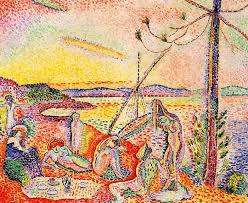
Henri Matisse, Luxe, Calme et Volupté (Luxury, Calm and Pleasure), 1904-5
 oil on canvas, 98.5 × 118.5 cm (37 x 46 in), Musée d'Orsay, Paris.

It is time to bid a fond farewell to a fabulous show at the Metropolitan Museum of Art. These moments always bother me: so sad, so final.   How many shows have completely captured our hearts and faded away into our memories?  No catalog - no matter how thorough or well organized - can replace an excellent exhibition of works brought together from public and private collections for the sheer pleasure of observing the artist's mind.  We see in Matisse: In Search of True Painting the process of "condensation" that transformed an early concept into a masterpiece.  

As Matisse explained in "Notes of a Painter," (La Grande Revue, December 1908):
"I want to reach that state of condensation of sensations which makes a painting.  I might be satisfied with a work done at one sitting, but I would soon tire of it; therefore, I prefer to rework it so that later I may recognize it as representative of my state of mind." [from Jack D. Flam, Matisse on Art, E.F. Dutton, 1978,  page 36.]

If I were the curator, I would have called this particular Matisse exhibition Luxe, Calme et Volupté (Luxury, Calm and Pleasure) - after his 1904-5 painting pictured above - to emphasize the nature of the artist's search and interpretation.  For Matisse chose to convey intense feeling, rather than an intellectualized observation.  ["My choice of colors does not rest on any scientific theory."]   Most notably he relied on academic subjects, such as recumbent nudes or seated women, which he then reduced to their essential condition.  Here, there is nothing but the luxury of indolence (calm), perfumed with sensuality (pleasure) achieved through the radiance of color and voluptuous lines.  The viewer, therefore, is transported - carried by the power of suggestive visual stimuli, to a state of "au-dela" (the beyond).

"Luxe, Calme et Volupté " is a refrain in Charles Baudelaire's poem "Invitation to a Voyage" (1852).  Matisse at the Met invites us to one more voyage before 5:30 pm on Sunday.


Happy St. Patrick's Day, 
Beth New York
aka Beth S. Gersh-Nesic, Ph.D.
Director
New York Arts Exchange


Thursday, March 14, 2013

Celebrate Asia Week with Masako Inkyo at Friedman Vallois, March 12-28

Masako Inkyo,  Hyakunin Isshu (One Hundred Poems by One Hundred Poets),
Hyakunin Isshu, compiled by Fujiwara Teika (1162-1241),
 a celebrated anthology of 31-syllable-poems by 100 poets


It's Asia Week New York 2013 - please join me in celebrating Masako Inkyo's participation through Onishi Gallery:


HERITAGE

Japanese Works of Art by Contemporary Artists

March 12 – 28, 2013

Opening Reception
Thursday March 14th, 5 – 8pm


Location During Asia Week

27 East 67th Street, 2nd Floor
New York NY 10065


Hours of Exhibition
March 12 –15, 11am – 5pm
March 16 – 23, 10am – 6pm
March 24 – 28, 11am – 5pm
other times by appointment


Contact
Nana Onishi | Onishi Gallery | +1 917 214 8108

Dewamata,
Beth New York

aka Beth Gersh-Nesic, Ph.D.
Director
New York Arts Exchange
www.nyarts-exchange.com 


Sunday, March 10, 2013

Death by Art: Art Week NYC 2013


Stas Orlovski, Figures, 2012
ink, charcoal, gesso and xerox transfer on paper
68 x 31 inches
Courtesy of Mixed Greens, at Volta NYC (2013)


Conceptually, the art fairs make sense.   Perceptually, they don't.  Crammed into white cubicles or splayed out among funky furnishings, the art-ness of most pieces seems diminished and disrespected.  "Fair" (as in carnivalesque) is indeed the overriding spirit.  "Fair" (as in justice) - forgetaboutit.  Row upon row of art-filled cubbyholes demand attention that is in short supply.  It's depressing - even more so when two or three gallerini huddle over their laptops in an empty exhibition.  It must feel degrading to watch various clutches of art glitterati gravitate to other white cubes without so much as a frozen smile directed your way. My heart goes out to these vigilant gnomes (they all look alike to me) stranded like misfits at a party run by the "popular" crowd. 

Does the art suffer too?  Well, maybe not.  Most of the art on view aids and abets today's frivolous banality - clever ideas with nothing really interesting to say. Unfortunately, some earnest artists unwittingly cheapen their efforts amid the boring din. 

Better to savor the art experience in individual galleries, which project a mastery of their own domains. Aesthetically calculated (really elegant stores), galleries protect their subjects (both the artists and the art).  

Art fairs, on the other hand, feed these vassals to the lions.

For a quick over-view of the Art Fairs, free of charge, please visit the Blouin Artinfo's website.  Then get off your duff and sample nature.  Today feels like the first day of spring!


Dovidjenja,
Beth New York

aka. Beth S. Gersh-Nesic, Ph.D.
Director
New York Arts Exchange

Friday, March 8, 2013

Robin Glass Video Installation Celebrates Art Week NYC 2013 at 287 Spring Gallery


Robin Glass


287 Spring Gallery and Performance Space celebrates Art Fair Week NYC with Robin Glass' video installation Rice and Beans (2012).   An Anglo-Brazilian, Glass blends music and images to create thought-provoking experiences few words can adequately express.

The exhibition is on view from March 8 through March 10.

287 Spring explains:

Rice and Beans is a collective portrait of humanity, with its recurring, compulsive, and absurd need to polarize. It is a poem of interventions – subversive and courageous acts of crossing boundaries to reach our invented opposites. This work is a gracefully provocative attempt to tread a vital path through the crevasses of our myopic binary beliefs.
Rice and beans, a staple in Brazil, an allegory here, are shown in their raw and grainy form, as opposites. Throughout the film, two reels play side-by-side on a divided screen as negative reflections of each other, in a sequence of four acts. Within each act, the binary of black and white switch places, united in their desire to overcome the eternal divide, yet unable to cross over.
The soundtrack (composed by Glass) blends the Berimbau (a traditional Brazilian instrument) with the more familiar sounds of pianos, keyboards and voices, and forcefully evokes the formal and semantic tensions between the images on the screen. A shower of beans and rice challenges the dissonant chords of a piano, while the speeches by Barack Obama and Osama bin Laden project the polar aspirations of their followers, and voices from the East and West become an inseparable – yet constantly conflicted – whole.
Rice and Beans is both classical in its formal construction, and boldly modern in its attempt to break the continuing divisions of culture, race, gender, politics, and sex.

Artist bio:
Robin Glass is an Anglo-Brazilian artist, musician and filmmaker. Glass comes from an eclectic background, in which his film career is a recent addition. Trained in theology and fine arts, he has worked as a business executive, NGO director, musician, diver, lecturer and artist, among other professions. Robin’s work has been presented internationally, receiving critical acclaim and a number of awards. 

The presentation of Rice and Beans at 287 Spring Art Gallery & Performance Space is Robin’s first solo show in New York."


_________________________________________
I recently discovered Glass' video Regret online.   Unforgettable:


Art Fairs NYC 2013:

Armory Show, 12th Avenue at 54 Street (Overview on Art.sy): 

The Art Show: ADAA, Park Avenue Armory at 65th St.

Volta, 82 Mercer Street

Scope, 312 West 33 Street, between 8th and 9th Avenues

Independent, 548 West 22nd Street

(Un) Fair, Anti-Armory Show, 500 West 52 Street


Com carinho,
Beth New York

aka Beth S. Gersh-Nesic, Ph.D.
Director
New York Arts Exchange


Sunday, February 24, 2013

Queen Esther in Art - Celebrating Purim 2013

Edward Millais, Esther, 1865
Private Collection

Today is Purim, the Feast of Esther, which celebrates the courage and clever wiles of a young woman who was asked to save her coreligionists (the Jews) from annihilation. On Purim, one donates to those in need, delivers gifts of sweets to friends and family, and celebrates at a festive meal - with permission to drink until "one cannot tell the difference between Mordecai and Haman."

The story of Esther begins with her predecessor Queen Vashti, who refuses her husband King Ahauserus' summons to appear before his guests at his banquet to celebrate seven years as the ruler of the Persian Empire.  

Edwin Long, Vashti Summoned by King Ahasuerus, 1878
Wikimedia Common

The king's angry advisers insist that her insubordination should not be tolerated. Vashti is sent into exile.


Fra Fillippino Lippi, Vashti Goes into Exile, c. 1480


Lonely without a queen, Ahasuerus calls all the eligible maidens to his palace to compete for his favors. Hadassah, a Jew, answers the call at her cousin-guardian Mordecai's urging, but she changes her name to Esther ("star" in Persian) to mask her ethnic identity. After a year of preparation for her night with the king, she adores herself with little more than her charms.

Théodore Chassériau, Esther Preparing to Meet King Ahasuerus, 1840
Musée du Louvre

Esther's beauty and grace enchant the king. She becomes his bride:

Aert de Gelder, Esther Prepared for her Wedding, 1684


Unfortunately, her happiness hits a snag.  Mordecai  refuses to bow down to the king's prime minister Haman. Again, insubordination has its price. Haman seeks revenge and  arranges for the death of all Mordecai's coreligionists, the Jews, on the 15 Adar (chosen by lots - "purim") and seals the deal with the king's stamp.

Mordecai contacts Esther through a messenger to ask for her intervention.  


Aert de Gelder, Mordecai and Esther, 1685 
(or perhaps, a servant before Esther)
Museum of Fine Art, Budapest

The decision to appear before the king without his permission may result in her death (as Vashti, was exiled - or executed - when she refused to appear before the king at his banquet).  The king will decide Esther's fate. Nevertheless, she acts on behalf of her people and to save herself as well. 

Giovanni Andrea Sirani, Esther Before Ahasuerus, 1630s
Museum of Fine Art, Budapest

I
Esther enters the king's throne room with her servants and finds the king happy to receive her. He encourages her petition and she cleverly invites him to her private chambers for a small banquet in his honor.  The guest list is short: Esther, Ahasuerus and Haman. The meal pleases the king and Haman. She invites them to another dinner party the next day.  

That night the king cannot sleep and has his servants bring his book of chronicles to lull him to slumber. The record of deeds includes Mordecai's report of a plot against the king.  The king calls Haman to his bedchamber to consult on a fitting gesture for "a man who has honored the king."  Crafty Haman assumes the triumphal procession will be for himself.  Instead, Haman ends up leading Mordecai mounted on the king's finest horse through the streets of Susa announcing "this is what becomes of those who honor the king."

Jean-François de Troy, The Triumph of Mordecai. ca. 1736
Metropolitan Museum of Art

The next night, at Esther's second banquet, the king compliments Esther profusely and pledges all manner of gifts to her to express his gratitude. She points to Haman to expose his evil intentions. The king is incensed and leaves the room to cool off.  Haman falls to his knees before Esther to plead for his life. The king returns to see his prime minister touching his wife's hem, which inflames the king's ire to a greater degree. Haman is sentenced to death on the gallows he prepared for Mordecai's public execution on the 15 Adar.


Jan Steen, The Wrath of Ahasuerus, 1668
Cleveland Museum of Art

Mordecai becomes the prime minister in Haman's place. Then the king permits the Jews to defend themselves on the 15 Adar, as he cannot repeal his own law. Mordecai and Esther draft a law to remember this day.  

Aert de Gelder, Esther and Mordecai Writing the Second Letter for Purim, ca. 1685
Rhode Island School of Design Museum of Art, Providence

The celebration of Purim follows this law and inspires courage in the face of circumstances that seem beyond our control.

What can you do to make the world into a better place for everyone?  Think of Esther and give it your best shot.

Chag Sameach - and Happy Oscar parties to you all,
Beth New York

aka Beth S. Gersh-Nesic, Ph.D.
Director
New York Arts Exchange