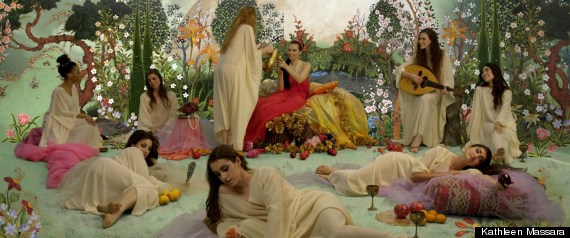
"The Unicorn in Captivity," from The Hunt for the Unicorn tapestries, c. 1495-1500
The Cloisters, Metropolitan Museum of Art
A Gift of John D. Rockefeller, Jr., 1937
I am running to Washington Heights this afternoon to see The Cloisters' charming exhibition In Search of the Unicorn for the last time. This small collection of art and artifacts which depict a beloved mythical creature deserves another unhurried visit before we must say adieu (not to the tapestries but the installation).
I love The Cloisters: compact and serene. A few hours yield plenty to consider and yet the search never feels completely exhausted. Plus the whole setting (museum and grounds) provides a mini-vacation from the 21st century just a few blocks from the 190th Street subway station (A train) or at the northern terminus of the M4 bus. Time-travel on the NYC transit system - or in your own car (there is convenient parking right in front of the entrance) - was never as easy or inexpensive.
In Search of the Unicorn celebrates the 75th anniversary of The Cloisters' existence. Based on a collection of assorted cloister architecture which the sculptor George Grey Barnard (1863-1938) brought from France to New York in 1914, the museum (it is not a replica of a medieval monastery as is often mistakenly believed) opened it doors in 1938 with some additions from its mother museum, the Met, and its benefactor John D. Rockefeller Jr., who shepherded the project from start to finish. Among the Rockefeller Bequest were the precious Unicorn Tapestries which had been purchased from Count Gabriel de la Rochefoucauld whose family owned the works as far back as 1680 (according to their inventory) and perhaps even longer. The tapestries were probably made in Brussels around 1500, as the abundance of flowers throughout seems to be an excellent example of Belgian mille fleurs design and the figures wear fashions contemporary with that date.
The Metropolitan Museum created an impressive online exhibition to accompany the show. There you will find the history of unicorns in literature, the story that unites the Unicorn tapestries and the tale of their acquisition. So even if you cannot rush out to The Cloisters on August 18th, you can learn a good deal about the tapestries and the museum right now - or later.
Forgive me for not urging you to visit this exquisite exhibition sooner. Who knew the Met would close a summer show in the middle of August! Labor Day must be just around the corner (17 more days to be exact).
It's 8 pm on the last day/night of Random International's Rain Room (2012) at the Museum of Modern Art - and it's raining outside. I imagine people are now standing in the rain, waiting to enter the Rain Room, which is the experience of standing in the rain without getting wet. Someone has to point out the irony in all that - it's too delicious to let slip by without a comment.
Announcements were sent out to inform the public that the show would close at 12 midnight to accommodate those die-hearts unperturbed by standing in line for as little as 1 1/2 hour (members) and as much as 8 hours or more. Once inside the Rain Room, you can stay as long as you like - but only 10 people may stand inside the room at one time. (One wonders which MoMA wunderkind thought that this was a good idea for a city of millions and its thousands of summertime guests - not.) As of last weekend, over 70,000 visitors braved the challenging New York heat for fear of missing out on this much-talked about attraction.
If you are like me, however, and can't spare 1 hour - let alone 8 hours - for just about anything these days, take heart. We still have videos. Here is one with the artists as your guides:
And at the Barbican Gallery last year:
Or you may share my "rain room" on the porch, gently perfumed with Nature's own refreshing blend.
"Because life leads inevitably to death, these pictures are about all of us."
--- Rosalind Solomon,"Artist's Statement," Portraits in the Time of AIDS, 1988
From May 17 through July 2, 1988, the exhibition Rosalind Solomon: Portraits in the Time of AIDS filled the rooms of New York University's Grey Art Gallery with its large 32 1/2 by 32 1/2 inch square, black and white photographs, attached to a beige fabric wall with ordinary push pins. The installation seemed uncharacteristically stark and vulnerable for this tony Greenwich Village venue. Each photograph focused on a few anonymous people (the afflicted, their families, their friends and their lovers). The entire experience of the images (unprotected by the glass of conventional framing) performed a visceral confrontation as well as an intimate encounter for the viewer.
Solomon's portraits also became a visual collaborative essay produced by the sitters and artist as they decided on the settings, poses and circumstances. Sometimes at home, sometimes in a hospital, sometimes in the arms of loved ones, Solomon strove to capture the individual as simply that: a person, whose body turned into battlefield inside and out. The emotions run the gamut, from the appearance of isolation to affectionate embracing, from wistful mediation to active defiance. In each, we are forced to consider a vibrant personality tested by pain, trauma and confronting the inevitability of death.
In 1988, the Grey Art Gallery exhibition intended to break through the vicious stigma, instigated by the media and ignorant hearsay, that had turned people with HIV into social pariah because the public feared contamination. In 2013, hopefully, we are wiser and more compassionate. Today, these portraits memorialize the victims and historicize the moment.
The Grey's director at that time, Thomas Sokolowski, had discovered Solomon's work in the fall of 1987 and asked her to complete the series for a spring opening. The experience for both artist and curator was unusual, but necessary. AIDS (Acquired Immune-Deficiency Syndrome) was on the rise, destroying scores of populations everywhere. The medical community, the arts community and the gay community - among others - felt an enormous urgency to stop this predator and cure those already afflicted with the condition. Rosalind Solomon: Portraits in the Time of AIDS (a title inspired by Gabriel Garcia Marquez's 1985 novel Love in the Time of Cholera, translated into English in 1988) attempted to enjoin this zeal through fostering a personal connection through portraiture.
Solomon wrote in her statement for the current reprisal of the 1988 AIDS show, now at Bruce Silverstein Gallery:
In my practice, I am interested in breaking down stereotypes. Though I am always aware of the social and political context in which I am working, my pictures raise issues. They do not give answers. Wherever I am, I connect on a gut level. I never gloss over the raw realities of life. I do not tell people what to believe, but cause them to confront their assumptions. I take them to the places where I have found connection with strangers and their lives. My convictions and confusions intermingle as I meet individuals living with emotional and physical stress. I think that viewers reminded of their own problems, find this disturbing. They face their own mortality.
Photographing people with AIDS and those in their lives was a wrenching experience. For a year of my life I met individuals facing the affliction. My life was all about AIDS. It was total immersion. When the show opened, for the most part, it was ignored or got negative reviews. I was accused of exploitation. Most of the people in the photographs exhibited came to the opening of the exhibit and liked it. They knew that they were being memorialized. After that year, I worked on other projects and tried to put the pain that I felt behind me.
Rosalind Solomon remains one of America's most important artists whose primary media is photography. This particular series in her oeuvre features individual portraits (as opposed to genre pieces) and, therefore, is unique among her other endeavors.
In general, Solomon's photographs bear witness to the extraordinary in our times: the strong, the mysterious, the tragic and the beautiful. Elsewhere I have written about her photographs of rituals.
I look forward to hosting an evening with Rosalind Solomon on September 10, 2013 at 287 Spring Gallery and Performance Space, beginning at 7 pm. An exhibition of selected works will open as well, continuing through September 17th. Please save the date and join us.
Moise Kisling, Portrait of André Salmon, 1912 and Portrait of Jeanne Blazy-Escarpette Salmon, 1919
Poem Read at André Salmon’s Wedding
July 13 1909
Seeing the flags this morning I didn’t tell myself Behold the rich garments of the poor Or democratic modesty wants to veil its sorrow Or honoring liberty now makes us imitate Leaves o vegetable liberty o sole earthly liberty Or the houses are ablaze because we’ll leave never to return Or these restless hands will labor tomorrow for us all Or even they’ve hanged those who couldn’t make the most of life Or even they’ve renewed the world by recapturing the Bastille I know it’s only renewed by those grounded in poetry Paris is decked out because my friend André Salmon’s getting married there
We used to meet up in a damned dive When we were young Both of us smoking and shabbily dressed waiting for sunrise Smitten smitten with the same words whose meanings will have to be changed Deceived deceived poor kids and we still didn’t know how to laugh The table and two glasses became a dying man who cast us Orpheus’ last glance The glasses fell shattered And we learned how to laugh We parted then pilgrims of perdition Across streets across countries across reason I saw him again on the bank of the river where Ophelia was floating Who still floats white amongst the water lilies He went off amongst wan Hamlets Playing the airs of madness on his flute I saw him near a dying muzhik counting his blessings While admiring the snow that looked like naked women I saw him doing this or that in honor of the same words That change children’s expressions and I’m saying these things Recollection and Expectation because my friend André Salmon is getting married
Let’s rejoice not because our friendship has been the river that made us fertile River lands whose abundance is the nourishment all hope for Or because our glasses cast once more Orpheus’ dying glance Or because we’ve grown so large that many people confuse our eyes with stars Or because flags flap at the windows of citizens who’ve been content these hundred years to have life and trifles to defend
Or because grounded in poetry we have the right to words that form and unmake the Universe Or because we can weep without being absurd and because we know how to laugh Or because we’re smoking and drinking as in the old days Let’s rejoice because the director of fire and poets Love filling like light All the solid space between stars and planets Love wishes that my friend André Salmon get married today
Le 13 juillet 1909 En voyant des drapeaux ce matin je ne me suis pas dit Voilà les riches vêtements des pauvres Ni la pudeur démocratique veut me voiler sa douleur Ni la liberté en honneur fait qu'on imite maintenant Les feuilles ô liberté végétale ô seule liberté terrestre Ni les maisons flambent parce qu'on partira pour ne plus revenir Ni ces mains agitées travailleront demain pour nous tous Ni même on a pendu ceux qui ne savaient pas profiter de la vie Ni même on renouvelle le monde en reprenant la Bastille Je sais que seuls le renouvellent ceux qui sont fondés en poésie On a pavoisé Paris parce que mon ami André Salmon s'y marie Nous nous sommes rencontrés dans un caveau maudit Au temps de notre jeunesse Fumant tous deux et mal vêtus attendant l'aube Epris épris des mêmes paroles dont il faudra changer le sens Trompés trompés pauvres petits et ne sachant pas encore rire La table et les deux verres devinrent un mourant qui nous jeta le dernier regard d'Orphée Les verres tombèrent se brisèrent Et nous apprîmes à rire Nous partîmes alors pèlerins de la perdition A travers les rues à travers les contrées à travers la raison Je le revis au bord du fleuve sur lequel flottait Ophélie Qui blanche flotte encore entre les nénuphars Il s'en allait au milieu des Hamlets blafards Sur la flûte jouant les airs de la folie Je le revis près d'un moujik mourant compter les béatitudes En admirant la neige semblable aux femmes nues Je le revis faisant ceci ou cela en l'honneur des mêmes paroles Qui changent la face des enfants et je dis toutes ces choses Souvenir et Avenir parce que mon ami André Salmon se marie Réjouissons-nous non pas parce que notre amitié a été le fleuve qui nous a fertilisés Terrains riverains dont l'abondance est la nourriture que tous espèrent Ni parce que nos verres nous jettent encore une fois le regard d'Orphée mourant Ni parce que nous avons tant grandi que beaucoup pourraient confondre nos yeux et les étoiles Ni parce que les drapeaux claquent aux fenêtres des citoyens qui sont contents depuis cent ans d'avoir la vie et de menues choses à défendre Ni parce que fondés en poésie nous avons des droits sur les paroles qui forment et défont l'Univers Ni parce que nous pouvons pleurer sans ridicule et que nous savons rire Ni parce que nous fumons et buvons comme autrefois Réjouissons-nous parce que directeur du feu et des poètes L'amour qui emplit ainsi que la lumière Tout le solide espace entre les étoiles et les planètes L'amour veut qu'aujourd'hui mon ami André Salmon se marie Vive la Liberté, Beth New York aka Beth S. Gersh-Nesic Director New York Arts Exchange www.nyarts-exchange.com www.andresalmon.org
Gay Pride March 2013, begins 11 am at Fifth Avenue and 36th St.
New York Arts Exchange salutes Gay Pride Weekend with a big shout out to the Supreme Court for striking down the Defense of Marriage Act, of 1996. How wonderful to celebrate together this landmark decision.
With that in mind, I am thinking of Patricia Cronin's masterpiece Memorial to a Marriage (2002) and the significance of the work within the context of this new development. Will it lose its transgressive edginess which galvanizes so much of Cronin's work? Maybe . . .maybe not. Only time will tell.
Once again, here is my review of the artist's exhibition "Bodies and Soul" which took place in Washington, DC in 2011
Patricia Cronin, Memorial to a Marriage, 2002 in bronze and marble.
Patricia Cronin: Bodies and Soul, Conner Gallery, Washington, DC , Febuary 4 - March 10, 2011
In July 2010, this blog celebrated the marriage of New York artists Patricia Cronin and Deborah Kass, whose long-time commitment inspired Cronin's sculpture Memorial to a Marriage, 2002, permanently installed in Woodlawn Cemetery in the Bronx. The marble mortuary sculpture was meant to accomplish in death that which seemed - in 2002 - impossible in life.
Now the exhibition of the bronze version of this sculpture, on view at Conner Gallery in Washington, DC, celebrates the transition of this artwork from depicting a dream to immortalizing reality.
Memorial to a Marriage is based on Gustave Courbet's Sleepers or Sleep (1866)
Gustave Courbet, The Sleepers, 1866
and the American neoclassical tradition of the 19th century (Patricia Cronin studied and appropriated Harriet Hosmer's work for her exhibition Harriet Hosmer: Lost and Found (June 2009-January 2010).
On Father's Day 2012, I posted a review of Max Ferguson: Portraits of My Father on view at the Hebrew Union College from April 16 through June 29, 2012. It was a strange show: portraits of a father before and after he passed away. A bit melancholy with a touch of Magic Realism.
Then a few days later my own father passed away at the same age as Ferguson's, 92. A lot has happened in this year, including thinking often about Ferguson's portraits of his late father. It occurred to me that we all create an image in our minds of everyone, especially of the dearly departed. These personalized portraits, which are expressed in eulogies or shared reminiscences, actually expose our relationship with the other person and, as such, might teach us about ourselves if we take the time to examine our motives. With this in mind, Max Ferguson's paintings no longer seem so melancholy and weird. Rather they become invitations to contemplate our own fictitious portraits of our parents - and the degree to which we too mythologize the real person.
Here, once more, is the review of Max Ferguson's work:
Max Ferguson, My Father at a Water Fountain, 2011
oil on panel, 10 x10 inches, Courtesy of Henoch Gallery
Some critics see Edward Hopper's urban loneliness, some critics see Johann Vermeer's geometry. I see none of that, really. Max Ferguson's Post-Modernist Realism is warmer than Hopper's and more complex than Vermeer's. That complexity doesn't stop with his formal considerations. Ferguson takes on the complexity of a relationship. In this case, the Father and Son Relationship, which has so many dimensions. From hero worship to disillusionment, from constant camaraderie to unspoken boundaries, fathers and sons slog through different stages of their development together and, hopefully, remain friends.
In Max Ferguson's meticulous paintings of his father Richard Jacob Ferguson sometimes there is truth and sometimes there is fiction. I asked the artist a few questions so that I might understand his choices.
Me and My Father, 1986
oil on panel, 26 x 26 inches
Private Collection, Palm Beach Gardens, FL
BNY: Which paintings are inventions of your father in circumstances that
he would not have participated in during his lifetime?
MF: Buying TheForward, selling tickets at a movie theater. Playing pool with me.
BNY: How much of his true personality can we glean from your paintings?
MF: Some, but not all aspects. He was very physically active, and extremely funny, which I don't believe come across in the paintings. (Related. I have often thought that if someone had never met me, and just knew my paintings, they would have a radically inaccurate idea of me. Humorless? Constantly making jokes. A loner? Married with three children. Tranquil? A ball of anxiety and nervous ticks. Patient? Could not be less so...)
BNY: Do you feel that there is a bit of yourself infused in the person
you create on the canvas in the guise of your father?
MF: Absolutely. He and I are to some degree inseparable.
My Father in Katz's, 2005
oil on panel, 16 x 20 inches
Collection of the artist
BNY: Do you bring a deliberate concept to the characterization of your father?
MF: In one sense he is Everyman. In another sense he is very specifically my father.
People keep telling me they see their father in him, so is also a universal "father figure."
The more personal you get, the more universal you become.
BNY: You spoke about a kind of Proustian desire to preserve a moment in
time as you recognize how quickly modern life changes our immediate
environment. When did this desire first occur to you?
MF: I have always been hyper aware of the brevity and transience of life.
Never being one to quite accept the idea of death, I have long sought to hold back the hands of time. I tend to resist change of any kind. It is hard to pinpoint any moment, but this idea of freezing time and resisting change has always been reflected in my work; but not initially as a conscious element, or catalyst.
My Father in the Subway III, 1984
oil on panel, 22 1/2 x 28 1/2 inches
Collection of the artist
BNY: You explained that 17th century Dutch genre paintings have been a
major influence on your work. Would you call these paintings
portraits or genre paintings - or both?
MF: I think of them as genre paintings, but in a broader sense they are portraits.
BNY: Do you believe that the culture of the 1950s and 1960s plays a role
in your formation as an artist? Specifically, did the idealization of
the father in late 1950s and early 1960s television and movies: Father
Knows Best, The Donna Reed Show, Fury, Disney movies, etc. influence
your desire to idealize your father in your own art? Have you ever considered this
question before?
MF: I have never thought about that, but I suppose one's environment (especially as a child) cannot help but influence one's perception and concepts of the world.
[I recently found something I had written when I was 8 that said in effect:
"When I grow up I want to get a job so I can support my family."] I was literally a child of the 60's, and certainly watched a good deal of television of that ilk so I am sure the influence was there. I am certainly prone towards idealizing and romanticizing. Certainly it is difficult for me to escape certain imposed gender stereotypes. For example: I might have found it difficult to paint women playing pool, or a man lighting Sabbath candles (even though when single I did just that).
My Father at Mount Sinai, 2011
oil on canvas, 36 x 52 inches
Collection of the artist
BNY: You painted your father when he was alive and you continue to paint your father since he passed away in 2005 at the age of 92, perhaps to keep him alive in your daily life. How does it feel to bring your father to life on the canvas?
MF: As assiduously as I seek out realism in my paintings, I avoid it in my daily life.
No more concrete manifestation of reality than death. Mortality has never been my favorite thing. To continue to paint my father is both my way of dealing with his death and denying it simultaneously. To bestow on him a degree of immortality is my vain attempt to do the same for me. It is both resurrecting him (playing G-d in a sense), but also refusing to accept his death. It is comforting for me to still have him with me; if only two-dimensionally. Quotes from the catalog:
On My Father in Katz's: "I began working on this painting of him in Katz's Delicatessen a short time after his death in 2005. The whole time I was working on it, I kept asking myself if this was my way of dealing with his death, or not dealing with it, by trying to keep him alive via this painting. To stop painting him is to acknowledge his death. To accept his mortality, is to accept mine . . . " (p. 10)
On My Father in the Subway II: "I made the photographic studies for this in July, but my father was generous enough to wear a winter coat." (p. 18)
On My Father in Mount Sinai: "I often asked myself if my father would have approved of me painting this. The answer is no. Was I being disrespectful of him? I am not sure, probably yes. Still, I felt not so much that I wanted to paint this, but had to." (p. 35)


,+AIDS+series,+1987.jpg)

,+AIDS+series,+1987.jpg)