Monday, June 17, 2013

"Kathleen Gilje: Revised and Restored," Bruce Museum in Greenwich, CT through Sept. 8


Kathleen Gilje, Lady with an Ermine, Restored, 1997, 
oil on panel, 15 ¾ x 21 7/8 inches,  
Courtesy of the Artist, © Kathleen Gilje 2013 

Leonardo da Vinci, Lady with an Ermine (Portrait of Cecilia Gallerani) 1490
oil on wood panel, 15.0 x 21.6 inches, Czartoryski Museum, Wawel Castle, Krakow

Kathleen Gilje is an art historian's artist: a brilliant scholar and detective who can deftly copy masterpieces from different eras and then, with just an addition or subtraction of elements, transform the imagery into a highly charged, contemporary topic.

Known for her “restorations” (the artist’s term), Gilje’s appropriations grow out of a long and careful study of the each work of art.  She physically masters the artist’s style, material, and execution. Then she scrupulously researches the iconography, artist’s life and the socio-political context of the work in order to deepen her understanding of the artist’s decisions. Often her academic investigations uncover background stories or encoded narratives embedded in the art or swirling around the artist’s milieu that may inform her analysis. 

Gilje’s sly additions or adjustments in the works derive from her considerable research. Then, in an effort to break new ground, she paints revised art historical readings. Gilje calls this practice “restoration,” because she fantasizes a restoration of the meaning of the work which may not be visible in the original work itself.


Kathleen Gilje, Woman with a Parrot (Restored), 2001, 
Courtesy of the artist., © Kathleen Gilje 2013 

For example, in her 2001 “restored” version of Courbet’s Woman with a Parrot (1866) she replaced the bird’s perch with a nude male figure to emphasize the phallic symbolism of the original painting. The parrot in the Courbet may represent the petit ami who is privileged to gaze upon the female model [i] or the Kamasutra.   

Gilje painted her “restoration” of the artist standing over the frisky model and then painted an exact copy of the Courbet painting on top of her “restored” version. She had her exact copy x-rayed in order to show her faux “original” underneath the copy. Viewed as an installation, the 2001 copy of the Courbet painting placed next to the x-ray film of the “restored” version sparks a variety of associations. The perch clearly becomes the proxy for Courbet himself, who has eroticized his model for his own delectation.

Gilje’s installation also comments on scopophilia: pleasure derived from the act of looking, an aspect of the male gaze.[ii] In Gilje’s “restoration” of Courbet’s Woman with a Parrot, the artist enters into his own picture and experiences the pleasure of viewing the model directly. (The grainy texture of the x-ray also suggests that we are witnessing the artist’s dream or fantasy as he paints the nude with ardent desire.)

Gilje’s ability to alter the original iconography to serve her interpretation of the work elucidates what she believes lies beyond the physical evidence. In this way, she embarks on dialogues with art history’s masters that seamlessly integrate her feminist readings and sometimes incorporate the very history of the work itself.


Kathleen Gilje, Danaë, 2001, 
oil on canvas, 72 1/2 x 80 1/2
Courtesy of the artist, © Kathleen Gilje 2013 

Rembrandt van rijn, Danaë, 1643, 
Hermitage Museum, St. Petersburg


In her Danaë, Restored (2001), Gilje alludes to the vicious slashing and sulfuric acid attack on Rembrandt’s painting Danaë (1636), which occurred at The Hermitage Museum in St. Petersburg, on June 15, 1985.[iii]  Here, a puddle of acid flies through the air toward the nude heroine, instead of the supernatural golden shower of rain (Zeus’ transmogrification in the myth) which Rembrandt painted in the original. Gilje explained in a conversation that the golden shower in the myth is the Greek deity’s semen which impregnates Danaë with Perseus. Gilje views this sneaky sexual encounter as a romanticized act of non-consensual sex: a form of rape.

Rape, the violation of another’s body, is a perfect metaphor for the attack on the Rembrandt painting in 1985. Gilje noted that Danaë’s gesture in the original painting was meant to welcome Zeus as the golden shower into her bower. In Gilje’s “restoration,” Danaë’s raises an arm in a feeble attempt at self-defense, warding off the approaching acid. In the Gilje appropriation, Danaë’s gesture emphasizes the vulnerability of the woman in the painting and the artwork itself during the violent attack at The Hermitage. The title of Gilje’s work reminds us that Rembrandt’s Danaë is now literally a restored work of art.

Gilje came by her ability to reenact the masters’ touch as an apprentice in Antonio DeMata’s studio for restoration from 1966 to 1968. Then, she went to Naples with DeMata and his other assistants to restore masterpieces in the Museum of Capodimonte from 1968 to 1972. In 1973, she returned to New York City, her hometown,[iv] to work for Marco Grassi, where she restored paintings for various collections, including the Thyssen Bornemizsa Collection in Lugano and Madrid and the Norton Simon Collection in Pasadena. In 1976, she opened her own studio, restoring works for numerous public and private clients, such as Stanley Moss, Eugene V. Thaw, and Robert Dance.[v]


Kathleen Gilje, Bacchus (Restored), 1992
oil on linen, 37 1/2 x 33 1/2 inches
Courtesy of the artist, © Kathleen Gilje 2013 

Caravaggio (Michaelangelo de Merisi da Caravaggio), Bacchus, c. 1595
Uffizi Gallery, Florence


Gilje’s concept of the “restored” painting (her Postmodern Appropriations) dates back to the early 1990s. Her Bacchus, Restored of 1992 (after Caravaggio’s Bacchus, c. 1595) features plastic wrapped over the bowl of fruit with condoms strewn alongside the succulent choices Caravaggio depicted in his original. Gilje’s “restoration” suggests that the beautiful young man in the seductively draped toga was indeed “forbidden fruit” for the patron Cardinal Francesco Maria Del Monte, who commissioned Caravaggio’s work and delighted in beautiful young men.[vi]

 Gilje’s Bacchus, Restored belongs to the horrific first wave of the AIDs epidemic and historically marks the overwhelming concern that gripped the arts community. Simultaneously, Gilje explored the iconography of homoeroticism in art, which had recently gained recognition as “queer” theory among academic art historians and critics.

Today, a wonderful selection of Gilje's oeuvre has been beautifully installed in the Bruce Museum, on view through September 8, 2013.   This venue, which has welcomed numerous exhibitions of Old Master art, perfectly complements Gilje's paintings and drawings with its warm colors and informative text panels. 

The exhibition catalog deserves high praise too.  It features essays by the executive director Peter Sutton, critic John Yau, art historian (and subject in two Gilje portraits) Linda Nochlin, art historian (and subject in one portrait)  the late Robert Rosenblum, and an interview between the artist and art historian Francis Naumann (who exhibits Gilje's work in his gallery Francis Naumann Fine Art).  It is an elegant book, packed with valuable information about Gilje's work and the original pieces she copied - a delicious art history textbook in its own right.

Nevertheless, the catalog is not the real thing.  Seeing is believing.  This rare opportunity to see a large portion of Gilje's formidable body of work in public ends one week after Labor Day and then heads out to other parts of the US.  Catch it while you can!

(The New York Arts Exchange features two tours of Kathleen Gilje's exhibition this summer: Tuesday, June 25 and Tuesday, July 9.  Please visit our website for details and to make a reservation www.nyarts-exchange.com)


[i] Mona Hadler introduced the notion that the parrot represents the privileged position of the male gazing upon the courtesan in her reading of her article “Manet’s Woman with a Parrot of 1866,” Metropolitan Museum Journal, v. 7 (1973): 115-122. Kam or Kamadeva, the god of love in Indian mythology, is best known for the Kamasutra. He flies through the air on his parrot. Therefore, the parrot can be associated with sensual love.
[ii] Laura Mulvey, “Visual Pleasure and Narrative Cinema,” Screen 16, no. 13 (1975): 6-18, was very much on the minds of feminist artists and art historians during the late twentieth century, as well as the feud between Linda Nochlin and Michael Fried on gender bias and artistic intentionality in Courbet Reconsidered (Brooklyn: Brooklyn Museum, 1988). Kathleen Gilje directed my attention to the two articles in this exhibition catalogue.
[iii] The assailant slit the female figure across the stomach and thigh with a knife and then threw acid against the canvas. It took twelve years to repair. Danaë was put back on view in the Hermitage in 1997. (John Russell, New York Times, August 31, 1997.)
[iv] Kathleen Gilje was born in Brooklyn.
[v] Information culled from the artist’s website www.kathleengilje.com and interviews with the artist. Her own work belongs to collections all over the world, including the Musée Ingres, Montaubon; the Weatherspoon Museum, North Carolina; and the National Museum of Women in the Arts, Washington, DC.
[vi] Donald Posner, “Caravaggio’s Homo-erotic Early Works,” Art Quarterly 34 (1971), 301-24.

(The essay is an excerpt from "Portrait as Performance: The Theater of the Self in Kathleen Gilje’s Series of Curators, Critics and Connoisseur," written to honor Dr. Alicia Faxon, professor emeritus, Simmons College, whose scholarship has always been a source of inspiration.  The complete version will be published in a forthcoming festschrift dedicated to Professor Faxon, organized by Simmons College, where I taught from 1989-1991.)


Best regards,
Beth New York

aka Beth Gersh-Nesic
Director
New York Arts Exchange

Monday, June 3, 2013

Last Call: Anselm Kiefer Closing on June 8th;


ANSELM KIEFER

Paul Celan: wir schöpften die Finsternis leer, wir fanden das wort, das den Sommer heraufkam: Blume
(We scooped the darkness empty, we found the word that ascended summer: flower), 2012
Oil, emulsion, acrylic, on photograph on canvas
110 1/4 x 149 5/8 inches  (280 x 380 cm )
Courtesy of Gagosian Gallery

Anselm Kiefer: Morganthau Plan, closes on June 8th at Gagosian Gallery, 522 West 21st Street.  Equally depressing and exhilarating in its magnitude (what we have come to expect from Kiefer), this exhibition introduces a new dimension in this German artist's thinking: "Beauty requires a counterpart. And in thinking about this flaw, the other flaw occurred to me as well: the Morgenthau Plan. For it too ignored the complexity of things."   Conceived by the United States Treasury Secretary Henry Morganthau in 1944, the so-called "Morganthau Plan" proposed that the transform most of Germany into an agricultural society might stymie industrial development, which might lead to another military build up and war. The plan was never executed.   

Kiefer imagines the enthralling beauty of flowers counterbalanced by the appearance of decay or blight. The press release explains:

Revisiting a process used earlier in his career, Kiefer paints directly onto color photographs of fields in bloom that he took near his property in southern France, then printed to fit canvases of various sizes. Der Morgenthau Plan depicts an area overgrown with flowers, rendered in thick impasto that completely obscures the original photograph. From top to bottom, the vast canvas dramatically transitions from light to dark, ending in a carpet of drab, black and green mulch.  Morgenthau Plan: Laßt tausend Blumen Blühen / Let a thousand flowers bloom conflates the travesty of the German post-war plan with Mao Zedong’s shrewd co-optation of the idealistic classical Chinese maxim, “Let a hundred flowers bloom; let a hundred schools of thought contend,” designed to expose and flush out anti-Communist dissidents. Kiefer reflects on the misappropriation of this passage for autocratic purposes: amid pastel blossoms, black petals spring up above the rest into a muddled ochre landscape.

I am fascinated with Kiefer's questioning of beauty in the service of art: can something be too beautiful to be meaningful? Do we need ugliness or darkness to feel a sense of the profound or serious?  This is a question I hope to pursue in the future.

For now, please join me on Thursday, June 6th at 1 pm at Anselm Kiefer: Morganthau Plan for a conversational tour with the New York Arts Exchange group.  And please be ready activate those brain-cells as we work hard to understand works of art.
  
We will also visit the Jeff Koons show at Gagosian Gallery, 555 West 24th Street, to cheer ourselves up after a heavy dose of Kiefer's sturm-und-drang.  

Please confirm your reservation for June 6th at nyarts.exchange@verizon.net.


I am off to Jackson's Mississippi Museum of Art to lecture on French Impressionism!

Auf wiedersehen/Au revoir,
Beth New York

aka Beth S. Gersh-Nesic, Ph.D.
Director
New York Arts Exchange

Tuesday, May 28, 2013

A Comment on Commencements - Celebrating New Beginnings for Everyone


'Tis time to celebrate auspicious endings and terrifying beginnings as newly-minted graduates (from pre-school to Ph.Ds) don their mortarboards to say farewell to a location, a community and a familiar rhythm of life. Commencements (which means "beginnings") abound all over, marking the end of a student's affiliation with an institution of learning and the beginning of another chapter in the book of life.  During these Commencements, plenty of speeches abound too (hours of them) in hallowed halls of academia far and wide.

Therefore in the spirit of "go forth and prosper" (Star Trek 101),  I have posted three commencement speeches that provide plenty of rocket-fuel for all of us to lift off from wherever we wish to "commence" this summer. 

First Lady Michelle Obama, at Spelman College in 2011, entreats us to find our 11 people to nurture and support.


Academy Awarding winning actress Meryl Streep, at Barnard College in 2010, urges us to cherish friendships and family above all else, for indeed those are the greatest rewards that life has to offer.


Celebrated author Jonathan Safran Foer, at Middlebury College in 2013, asks us to memorize the moment rather let digital recording replace our natural ability to remember (click on the Middlebury website).


"May the Force Be With You" (James Earl Jones, Purchase College Commencement, 2001),
Beth New York

aka Beth S. Gersh-Nesic, Ph.D. 
New York Arts Exchange

P.S. New York Arts Exchange Tour on Wednesday, May 29 at 1 pm: 
Please confirm your reservation: nyarts.exchange@verizon.net 

Tuesday, May 21, 2013

Last Call: Impressionism, Fashion and Modernity closes on Monday, May 27; New York 1993 closes at the New Museum on Sunday, May 26

Gustave Caillebotte (French, 1848–1894) 
Paris Street; Rainy Day, 1877 
Oil on canvas; 83 1/2 x 108 3/4 in. (212.2 x 276.2 cm) 
The Art Institute of Chicago, Charles H. and Mary F. S. Worcester Collection


The Metropolitan Museum of Art is about to close one of its best Impressionism exhibition in years.  That says a lot - as the Met owns some of the most outstanding examples of Impressionism on the planet, thanks to Louisine Havemeyer, whose buddy Impressionist Mary Cassatt gave her an insider's advantage.

However, Impressionism, Fashion and Modernity is something else entirely. Here the curators added display cases full of clothing and accessories from the era, as well as the fashion magazines oozing with au current fashion terminology.  It's all toute Paris among the gauzy muslims and embroidered piqués.  Most of the clothes are similar to the ones depicted in the paintings. One dress, in Albert  Bartholomé's  In the Conservatory (Madame  Bartholomé), c. 1881, is on view.
            
Albert Bartholomé (French, 1848–1928) 
In the Conservatory (Madame Bartholomé), ca. 1881 
Oil on canvas; 91 3/4 x 56 1/8 in. (233 x 142.5 cm) 
Musée d'Orsay, Paris, Gift of the Société des Amis du Musée d'Orsay, 1990


Summer Day Dress Worn by Madame Bartholomé in the Painting In the Conservatory 
French, 1880 
White cotton printed with purple dots and stripes 
Musée d'Orsay, Paris, Gift of the Galerie Charles and André Bailly, 1991


Above all, the exhibition brings together some of the most beloved Impressionist works within a hop-skip-and-jump from each other: Gustave Caillebotte's Paris Street: Rainy Day (1877); Claude Monet's Camille (1866) and Jean-Frédéric Bazille's Family Reunion (1867).  These works from Paris, Boston, Chicago, Copenhagen, Bremen, and London join with the Met's collection, including a few Havemeyer donations. 
If you are unable to catch the show before it closes on Monday, you might schedule a trip to the Art Institute of Chicago, the next venue on this grand tour (June 26 through September 22, 2013).
NB:  The Met's Holiday Mondays will end on Memorial Day Weekend.  As of July 1st, the Met will be open all 7 days of the week,  from Monday through Sunday, except on Thanksgiving and Christmas. This new policy follows on the heels of the Museum of Modern Art's, which switched to 7-days of the week on May 1st.  Way to go NYC museums.  Very tourist friendly - and we like that!
The New York Arts Exchange will tour Impressionism, Fashion and Modernity on Wednesday, May 22, beginning at 1 pm in the Grand Hall.  We will also tour the Punk show and view James Nares' video The Street (2011)  Please confirm your reservation at nyarts.exchange@verizon.net


____________________________________________________________
Closing on Sunday (and never open on Monday), the New Museum's exhibition New York 1993: Experimental Jet Set, Trash and No Star may be this Winter's sleeper.  (That's "may," not "is.")  Typical of the New Museum's art fare, it's a bit edgy in a hipster way (if I understand what "hipster" means - anyone care to help me with that?)  Catch New York 1993 before it's gone and save room for one of those gigantic pastries in the Birdbath Café.


A bientôt,


Beth New York
aka Beth S. Gersh-Nesic, Ph.D.
Director
New York Arts Exchange


Friday, May 17, 2013

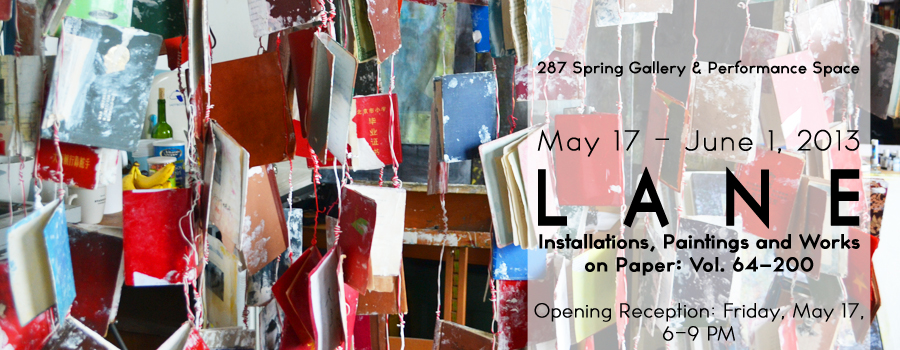
LANE Opens at 287 Spring Gallery, May 17 through Saturday, June 1


LANE: Installations, Paintings and Works on Paper Vol. 64-200


May 17 - June 1, 2013:
LANE : Installations, Paintings and Works on Paper Vol. 64-200
Opening Reception: Friday, May 17, 6-9 PM
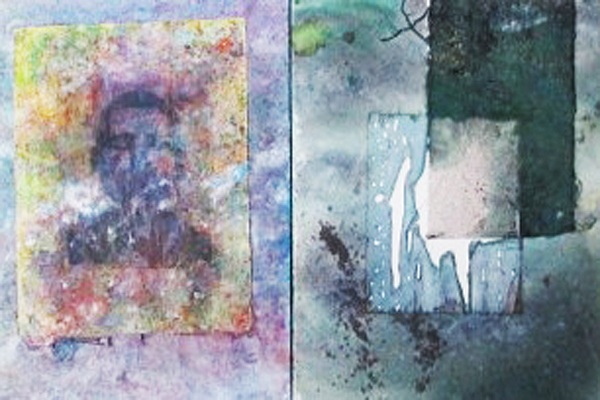
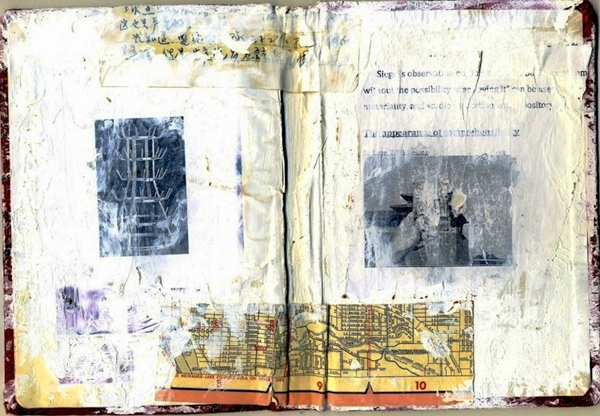
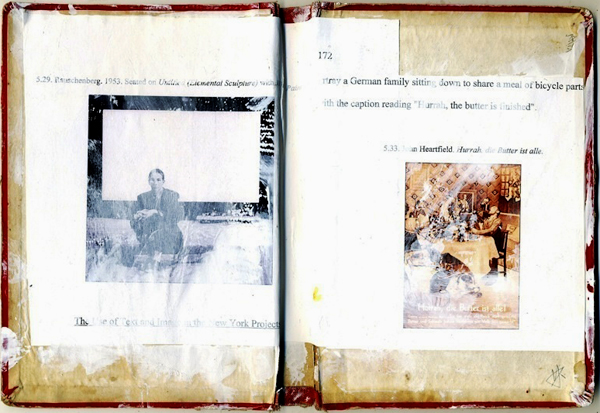
LANE’S art explores duality of forms and meanings through a combination of paint, canvas, books, political writings and anonymous diaries. In their totality, they present a survey of subtle corridors between representation and abstraction, image and text, as well as individual and collective identities in the East and the West. LANE accumulates elements for his installations from studio locations in New York and Beijing. The artist collects the discarded diaries of workers from the era of the Chinese Cultural Revolution and juxtaposes excerpts from his own writings on these historic and yet forgotten texts. 
Material is key to LANE’S art, not simply because, as representations of concepts and ideas, artworks are material objects, but because LANE’S engagement with the context of his work would be incomplete without equal regard to the formal qualities of the materials and the temporality embedded in them. There is a special currency  to LANE’S art - the ingredients of his works have been redefined and reworked in a manner, whereby echoes of the past and contemporary issues become disconcertingly similar and deeply personal.
This exhibition will travel to the Gallery COEXIST-TOKYO (Tokyo, Japan) on June 15 – July 7, 2013. For more information, please refer to www.coexist-tokyo.com.


Images and photos courtesy of LANE and Ivan Savvine, Curator, 287 Spring Gallery and Performance Space 


Many, many thanks,  Ivan and LANE -
Beth New York

aka Beth S. Gersh-Nesic, Ph.D.
Director
New York Arts Exchange
Wednesday, May 15, 2013

It's Shavuot - Let Us Eat Cheesecake and Drink in Art


Mark Podwal, Torah

Today is Shavuot, the holiday which celebrates Moses' receiving of the Torah from God on Mt Sinai.  Jewish or not Jewish, it's a great excuse to eat cheesecake and ice cream, for it is said that King Solomon compared the Torah to milk in the Songs of Songs, 4:11: "Like honey and milk, it lies under your tongue." Therefore, dairy products take center stage during all the festive meals: cheese blintzes, yogurt drenched salads, kugels, etc.

However, Shavuot is not just a day for showing off your favorite cheesecake recipe (or rushing to Juniors), it is a day to honor the best in us all, prescribed and supported by the golden rules that all moral codes share. Today we honor universal morality that inspires mutual kindness and selfless heroism. So, please take a break from the worrisome news that rattles our daily existence and have a huge ice cream sundae, contemplating the goodness in humankind - rather than the other stuff.

Last night, while I was reading my students' term papers, I took a break to watch a new film about Mark Podwal's current exhibition at the Jewish Museum in Prague (now on view at the Centre d'art et de culture - Espace Rachi, in Paris through May 26) and his beautiful textiles created for the Altneuschul, also in Prague. Here is the video:


My Synagogue is in Prague: Picturing Mark Podwal
a Czech television documentary about the life and art of Mark Podwal, with English subtitles.
 The 26 minute documentary chronicles Podwal's fascinating involvement with Prague 
and its seven hundred year old synagogue, the Altneuschul. 


The experience was quite moving, as I realized it was the beginning of Shavuot, the night all Jews should spend in the synagogue and pray. I wasn't literally in schul, but I felt transported to Altneuschul in time and space, revisiting a memory of being there many years ago.


Mark Podwal's images will be included in the Museum of Biblical Art's next exhibition, "As Subject ad Object: Contemporary Book Artists Explore the Sacred in Hebrew Texts," June 14 - September 29, 2013


Chag Sameach,
Beth New York

Beth Gersh-Nesic, Ph.D.
Director
New York Arts Exchange
www.nyarts-exchange.com


Thursday, May 2, 2013

Impressionists and Modern Masters Auction Exhibitions and Sales May 7 and May 8

Andre Derain, Madame Matisse, 1905


Spring Fever has finally hit the auction houses with three magnificent collections up for sale on May 7th and May 8th.  This weekend is the best time to feast on these visual banquets with the hope that many works will be snapped up by museums nearby.

Here is a video from Christie's to whet your appetite:


Christie's exhibition dates and hours:
May 4: 10 - 5
May 5: 1 - 5
May 6: 10 - 5
May 7: 10 - 5
May 8: 10 - 12; Sale at 7 pm

The New York Arts Exchange will visit the exhibition on Tuesday, May 7th at 1 pm.  Please make a reservation at nyarts.exchange@verizon.net 
Address: Rockefeller Center at 49th St., between 5th and 6th Avenues.


Amedeo Modigliani, L'Amazone (Woman in a Yellow Jacket), 1909

Click on this preview link to learn more about Modigliani's work featured in Sotheby's Impressionist and Modern Masters auction on May 7th.

Sotheby's exhibition dates and hours: 
May 3: 10 - 5
May 4: 10 - 5
May 6: 10 - 5
May 7: 10 - 1; Sale at 7 pm

Address: 1334 York Avenue, between 71st and 72th Streets.


Gustave Loiseau, L'Oise: Morning, 1908

Bonhams exhibition dates and hours:
May 4: 12 - 5
May 5: 12 - 5
May 6: 10 - 7
May 7: 10 - 3; Sale at 3 pm

Address: 680 Madison Avenue, between 56th and 57th Streets.


Happy Hunting,
Beth New York

aka Beth S. Gersh-Nesic, Ph.D.
Director
New York Arts Exchange